Troubled Over Bridgewater
Old Colony Correctional Center has been plagued by suicide, overcrowding, and brutality — and things are only getting worse
By CHRIS FARAONE | September 13, 2010
http://thePhoenix.com/Boston/news/108081-troubled-over-bridgewater/
On a winter evening around 11 pm, the former superintendent of Old Colony Correctional Center walked into a Rhode Island restaurant with a gun in his pocket.
Paul Murphy made his way through the dining room to the table where his recently estranged wife, Joan, was sitting with some friends. He sat down at the table and pointed the gun at her face. "I love you," he said. Then he squeezed the trigger. He shot his wife in the hand and neck, injuries she would survive. Murphy, a man who had overseen a prison of 750 souls, then turned the gun on himself and ended his own life.
The shooting, this past January 17, was senseless. But it was not unprecipitated.
The system that sustained Murphy — allowing a future killer to run a Massachusetts prison — is a microcosm of public penitentiaries nationwide. It's symbolic of a culture that often wreaks as much havoc on the families of prison personnel as it does on convicts and their relatives. But Old Colony, the prison Murphy ran, is particularly problematic, troubled by allegations of racism, sexual misconduct, and egregious human-rights violations.
An investigation by the Phoenix reveals that OCCC, located 30 miles south of Boston, appears to be especially toxic. The Massachusetts Department of Corrections (DOC) supervises more than 10,000 convicted criminals in 21 facilities. Within that system, despite its chronic failures, the medium-security OCCC has for years been overshadowed by problems at maximum-security state prisons in Walpole and Shirley, according to Leslie Walker of the Downtown Crossing–based Prisoners' Legal Services (PLS).
But now Old Colony is in the spotlight, for all the wrong reasons. In November 2008, 25-year DOC veteran and OCCC Lieutenant Gary Mendes was accused of stealing more than $100,000 from the department. The following year, convicted rapist Manson Brown escaped from OCCC's adjoining minimum-security facility, setting off a nationwide manhunt that lasted 37 days and catalyzed legislative action. And this past March, a lawsuit was brought against WHDH-TV (Channel 7) and the Boston Herald by the girlfriend of a prisoner. The woman charges that those media outlets knowingly slandered her with false information that was allegedly leaked by OCCC staff members as apparent retribution against her boyfriend, an activist inmate who had called for outside authorities to investigate the prison.
Those are just some bombshells signaling trouble over Bridgewater. In the past year, several elected officials and DOC Commissioner Harold Clarke have visited OCCC to address problems between Caucasian officers and minority inmates. Concurrently, at least two female employees were escorted off the grounds after being caught having sex with convicts. In a state where convicts reportedly kill themselves at more than three times the national rate, in 2010 OCCC is the facility where prisoners are most likely to commit suicide. Attorneys for a recently deceased prisoner who hung himself there say the inmate complained up until his death about being denied his anti-psychotic drug regimen as retribution.
According to documents obtained by the Phoenix and interviews done with prisoners, problems between convicts and OCCC officers have escalated in the midst of what appears to be chronic institutional dysfunction. Visits from top lawmakers including Governor Deval Patrick have failed to stem what activists allege is systemic abuse of black and Latino prisoners, who comprise 54 percent of the center's population. Among the allegations: officers intentionally disrespect such religious and cultural items as Korans; concerted efforts are made to suppress educational opportunities for minority prisoners; and physical and institutional retribution is carried out against convicts who file grievances. A group of black prisoners at OCCC who organize as the African Heritage Coalition (AHC) say they have been especially targeted. Internal reports show that this past winter officers cancelled a long-planned Kwanzaa celebration on false premises; inmate advocates perceive this as a dangerous symbolic gesture.
This all comes at a time when tensions between officers and administrators are particularly high due to department-wide overcrowding, and when severe financial restraints are causing further problems. For the first quarter of 2010, the Mass DOC operated at 141 percent of its designated capacity, exceeding the intended average daily statewide population by more than 3000 prisoners. OCCC currently holds about 755 convicts — nearly 300 more than the facility was designed for. In 2009, the state could not afford to pay Bridgewater an annual $187,000 prison mitigation payment that the town uses to protect itself in the event of a jailbreak. In July, the Massachusetts Correction Officers Federated Union (MCOFU) sued the DOC for overcrowding, alleging that the department is illegally and irresponsibly double-bunking convicts at the Souza-Baranowski Correctional Center in Shirley. The case was dismissed because the union could not prove administrative guilt, but overcrowding at commonwealth facilities remains an ongoing worry: it's the rare issue that officers and progressive prison abolitionists mostly agree on.
Past and current inmates, former administrators, officers, and numerous reformers say that OCCC conditions will only worsen, as the Mass DOC is in the process of transferring the state's most psychotic patient-prisoners to Bridgewater. That transition, begun in 2008, is intended as a cost-cutting measure, since concentrating special-needs convicts in one prison would allow the department to close costly psychological wards in penitentiaries statewide. In theory, human-rights crusaders, including those at the Massachusetts Statewide Harm Reduction Coalition, would support a plan to house mentally ill patients in a central institution. But they are concerned that, considering a slew of recent episodes, OCCC is not prepared for such an adjustment. As proof they point to the two suicides that have already taken place there this year — one of which occurred inside a mental-health unit.
"It does not appear that the facility is prepared to become a mental-health prison," says Walker, of PLS, who "has received a very high volume of complaints about OCCC staff who do not have the training of temperament to work with these challenging prisoners.
"The misery level for mentally ill prisoners at OCCC," she adds, "is very high right now."
Even before the DOC began transferring its most unglued convicts there, observers say OCCC was already, in many ways, the most out-of-control prison in all of Massachusetts.
"Old Colony was a hellhole from the day it opened," says Robert Dellelo. A prison reformer with the American Friends Services Committee, Dellelo served four years at OCCC before escaping in 1993. (It was his third jailbreak; he eventually served the remainder of his sentence at other prisons.) "But now it's going to become the hiding place for these [mentally ill] people. I spent years in solitary confinement in the worst prisons in this state, and it's hard for even me to imagine what's going on in there right now."
A new beginning?
Since opening in 1987, OCCC has housed its share of high-profile convicts, from "Blizzard of '78 Killer" Gerald Hill, to Anthony Warren, who was found guilty of shooting three-year-old Kai Leigh Harriott in Dorchester seven years ago, leaving her paralyzed. Other notorious guests have included Anthony Clemente, who, along with his son, killed four diners when he opened fire in the Charlestown 99 restaurant in 1995; and more recently Neil Entwistle, the Hopkinton man who was convicted of slaying his wife and daughter and escaping to his parents' home in England.
"The name of Old Colony," says the OCCC Web site, "fosters a sense of hope and 'new beginning.' " OCCC was conceived more than a decade after the uprising at Attica and highly publicized turbulence at nearby MCI-Walpole (now Cedar Junction), and it was designed in consideration of those hard lessons. For the first time in Mass DOC history, the original OCCC recruits spent a month learning basics, worked on the line, and then, only after deciding they could handle the job, trained at the academy in Shirley. Experienced officers were brought in from other state prisons in the hopes of fostering a fresh start in a new setting.
To lead this idealistic experiment, DOC brass selected former Walpole superintendent Joseph Ponte to run OCCC. Ponte had a reputation for effective, if heavy-handed, tactics, and was considered a good pick for the assignment. According to one former OCCC employee who was present at the beginning: "When you look at all of the facilities, OCCC was always regarded as having one of the healthier cultures — mostly due to the leadership and management. It also helped that when Old Colony was first staffed, the economy was such that it could have its pick of applicants."
But in the immediate wake of the commonwealth crack era, overcrowding became a problem. As early as 1990, many prisoners were forced to double bunk, even though 60 new cells had been added to the original 450. The OCCC that Paul Murphy oversaw, in the late 1990s and early 2000s, had in many ways become indistinguishable from other medium- and maximum-security prisons in Massachusetts — operating well above its intended capacity, and plagued by the same neglect and violence that has marred corrections culture in this state for more than a century. In 2002, the Southeastern Correctional Center — which was located in the same Bridgewater complex as OCCC — was closed due to budget problems. Its 610 residents were moved to other facilities, including Old Colony. As an added stressor, from that point on, staff and administrators were also responsible for the 100 convicts housed in the adjoining OCCC minimum-security unit, which previously had enjoyed its own organization.
The ongoing plan to convert OCCC into a facility specializing in mentally ill patients was conceived in response to news in 2008 that the DOC population had hit an unprecedented 12,000 inmates — 44 percent over capacity, well over the nationwide average of just seven percent. In addition to calling for reform in mandatory-minimum sentencing for non-violent offenders, Clarke, the DOC commissioner, sought to cut costs by consolidating mental-health services in Bridgewater. Contacted by the Phoenix for comment on the transition, DOC spokesperson Diane Wiffin said the move "allows for the creation of a therapeutic environment, enhanced training for staff, specialized modalities for treatment, concentration of clinical staff, and coordination with expert resources at [the adjoining] Bridgewater State Hospital. A new management team has been installed, training is ongoing, and a population shift is underway, with the expectation of completion in the fall."
But reform advocates, including those at Prisoners' Legal Services, say their clients tell a different story. And a former high-level DOC administrator tells the Phoenix, bluntly: "They had no plan, and if they say that they have one now, it's not something that was drafted beforehand."
Plan or not, suicide remains a serious issue throughout the DOC.In 2006, the department commissioned an independent study in response to the more than 3200 suicide attempts and self-inflicted injuries in Massachusetts prisons in the previous decade. The final report — ordered by former DOC commissioner Kathleen Dennehy, written by suicide-prevention expert Lindsay Hayes, and released in early 2007 — found systematic flaws in everything from guard training to cell design, and singled out OCCC for having just one night-duty officer responsible for checking multiple units where at-risk convicts were housed. In December 2007, a Boston Globe investigation revealed that suicides in commonwealth penitentiaries were "coming at an alarming pace, roughly triple the rate in other states."
These days OCCC is double-bunking mentally ill prisoners — a new arrangement that has both officers and reform advocates extremely nervous. The DOC laid off more than 40 mental-health workers in 2009. The consensus among observers is that the department is remiss in its duty to adequately train officers to deal with psychologically troubled prisoners.
Wiffin, the DOC spokesperson, describes recent Old Colony suicides as "specific to the individual" rather than institutionally motivated. But in July, the DOC re-hired Hayes to follow up his 2007 report. The state had little choice in the matter; recent developments have made headlines beyond the prison news network.
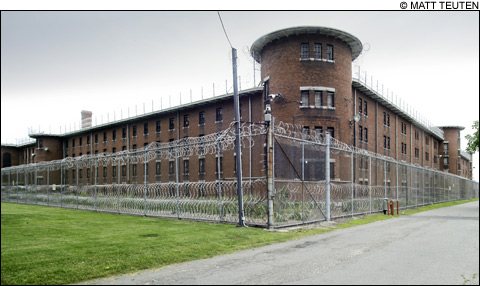
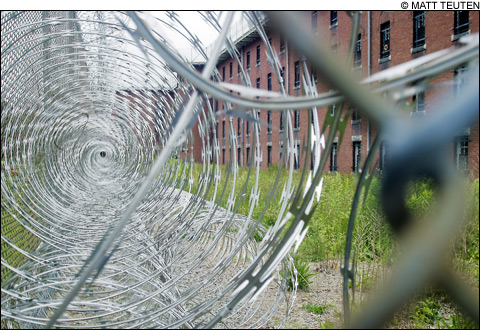
BEHIND THE FENCE: Lately, Old Colony has been in the spotlight, but for all the wrong reasons. The facility is troubled by allegations of racism, sexual misconduct, and egregious human-rights violations. And in a state where convicts reportedly kill themselves at more than three times the national rate, in 2010 OCCC is the facility where prisoners are most likely to commit suicide.
Wall of silence
In December 2006, an officer named Joel Weinrebe was terminated from his employment at OCCC. Court documents show that events leading up to the 10-year veteran's dismissal included a melee from two years earlier, when Weinrebe dragged his girlfriend by her hair down a flight of stairs and beat her on the cold concrete outside his Brockton home. When police arrived on the scene, Weinrebe, despite being on suspension from the DOC at the time, was carrying a loaded gun and wearing his department-issued badge around his neck. Six months later, he was arrested for the incident and charged with possession of a class D controlled substance, carrying a dangerous weapon, and domestic assault and battery. Weinrebe's girlfriend later dropped the domestic-violence charges, but he didn't get his job back.
The most revealing part of Weinrebe's case is what one of his fellow guards said, on the witness stand, about DOC culture. Steve Kenneway, then the president of the Officers Union, had previously been an Army officer at the notorious Abu Ghraib prison in Iraq. At a 2006 hearing for Weinrebe's appeal to be reinstated — which was denied — Kenneway testified that Weinrebe should keep his position at OCCC. According to court records: "Lt. Kenneway testified on behalf of the Appellant that domestic violence is becoming more prevalent among DOC personnel and that DOC requested a meeting to discuss this problem. Kenneway further testified that a Captain who shot his wife and spent six months in jail is still a Captain after the case against him was dropped. He also testified that there is a current case pending regarding a Captain who pistol-whipped his wife, and is still a Captain."
Offensive as his comments may have been, Kenneway was just following guidelines. Union members are candid about their brotherly discretion, so much that the Officers Union once published a list of commandments including: "Though shall not 'rat' on a fellow employee," "Thou shall not surrender thyself to management," and "Though shall not bear witness against one another." In a 2006 review titled "Improving Prison Safety: Breaking the Code of Silence" that was published in the Journal of Law & Policy, former DOC commissioner Dennehy wrote: "Corrections professionals must face the fact that we work in an environment where a long-established code of silence can flourish and overshadow common sense and common decency." The Officers Union did not return Phoenix requests for comment.
Old Colony's stop-snitching culture is a recurring theme on public Web forums where DOC employees post anonymous notes. One current target of officers' angst is Mendes — the previously mentioned lieutenant accused of scheming the DOC out of thousands of dollars that he allegedly used to buy, among other items, a bow and arrow and multiple semi-automatic weapons. (Mendes's attorney denies the charges.) Fearing that Mendes will flip in order to pad his own punishment, commenters have suggested the use of intimidation: "Mendes is being arraigned on the 28 of July in Brockton [Superior Court]" read one recent thread. "Let's get together and hire a bus to go and see this rat bastard sweat and cry in court. This ballsucker should go down like the coward he is."
Mendes is not the only contentious topic in OCCC forums. On the Bitch Boards, as they're better known, officers chat about everything from sexual-misconduct investigations and union elections to specific prisoners and co-workers. They have plenty to bitch about. In the past year alone: former officer Robin Pearson was arraigned on charges of having inappropriate sexual relations with a convict. Manson Brown escaped OCCC minimum-security, bringing the state legislature's attention to the prevalence of contraband cell phones behind bars. (Brown's escape also strained relations between prison officials and the Bridgewater Police Department, since Old Colony officers did not alert local authorities until two hours after discovering that Brown was missing.) All this while emotionally disturbed inmates are being transferred to OCCC, and the struggle between Caucasian guards and minority prisoners seems headed for an irreconcilable deadlock.
Unhappy Kwanzaa
The case of Darrell Jones illustrates how petty and vindictive the relationship between guards and inmates can be.
In 2008, Jones, a prison-reform activist who, at the time, was serving his life sentence at Old Colony, collaborated with Boston's Center for Teen Empowerment on the educational film Voices from Behind the Wall. In the documentary, he and other OCCC prisoners told cautionary tales of their trials on the street and behind bars. The film was made with the DOC's permission, but inmates claim the effort angered Old Colony staffers. Boston City Councilor Chuck Turner later suggested officers were dismayed that the film "linked [inmates] to the community in a positive way."
Jones was one of many inmates who clashed with OCCC staff over attempts to organize and educate minority inmates. Inspired by the prisoners at Walpole who four decades earlier converged as Black African Nations Toward Unity (BANTU) to study African-American history and resist systematic oppression, in 2008 Jones and other Old Colony inmates formed the African Heritage Coalition (AHC). The AHC alleges that through arbitrary sanctions, officers and administrators sought to cripple their group, which by early 2009 had grown to numbers in excess of 80 members. In May of that year, Jones charged, in an audio clip posted online, that officer harassment of inmates had reached its "highest level ever," and complained, "They're tearing down anything we try to do that's positive." The day after his tirade went public, Jones was placed in segregation.
Six days later, Jones' appeal for outside help appeared to have been answered: he received a visit from State Rep. Gloria Fox. Accompanied by Jones's girlfriend and collaborator Joanna Marinova, Fox had come to discuss claims of officer misconduct leveled by AHC members. The day after that meeting, Jones was relocated to MCI-Norfolk.
A civil action will examine whether OCCC officers manipulated the media to retaliate against Jones. In May 2009, the Boston Herald ran a page-one story titled "Fox in the Big House," in which reporter Jessica Van Sack wrote: "State Rep. Gloria L. Fox is under scrutiny for allegedly sneaking a murderer's girlfriend — previously bagged for engaging in 'sexual acts' with the killer con — into [OCCC]." Citing two confidential sources, the article claimed that Fox, the state rep from Roxbury, used her legislative privilege to bypass security checkpoints for the purpose of escorting Marinova into restricted areas where she could see Jones. In the month that followed, the Herald trumpeted the story despite proof in disciplinary reports that charges of "sexual acts" between Jones and Marinova had in fact been dismissed by OCCC supervisors. Marinova is suing the Herald and WHDH-TV7 over the story, claiming the outlets based their reports on false information that was maliciously leaked by OCCC employees.

A CIVIL ACTION will examine whether Old Colony officers manipulated the media’s reporting on a visit by State Representative Gloria Fox (above) to retaliate against a prisoner.
A complete loop
With aggravation building between inmates and administrators, in June of 2009 Commissioner Clarke and Governor Patrick visited OCCC to interview both sides. Among the grievances reported by inmates at the meeting, and that were recorded by AHC members, including Roxbury native Mac Hudson: OCCC employees "use policies and practices to discriminate against minorities in every facet of their institutional life," from job assignments, re-entry programs, and visitation policies to meal quality and recreational opportunities. Most damning were allegations that officers conspired against certain groups and individuals by manipulating the disciplinary process. Yet the DOC has no official report from this meeting, and refused to make the commissioner available for comment. Instead, a spokesperson tells the Phoenix that "Clarke is not aware of such [racial] tension."
Incidents of alleged prisoner abuse were investigated by an officer who was himself accused of prisoner abuse. In April of last year, OCCC's grievance coordinator — who processes inmate complaints — was accused of beating and choking a handcuffed minority prisoner, yet was allowed to continue working in that position.
While the allegations against him were still under review, the grievance officer handled another formal complaint by an inmate named Jackson Leonard. "The correctional staff are enticing inmates here with arbitrary rules and policies to cause a negative response," Leonard wrote. "I am afraid that this constant torture is going to cause hopelessness."
The grievance officer's official response sheds light on how such complaints were handled at OCCC: "I [sic] was determined through the investigative process that the Officers . . . are following there [sic] job duties to the letter of the Institutional rules, and it has been determined that they have been fair with [sic] in treating every inmate in [Leonard's unit]. Equally."
"This is an elaborate system that's a complete loop," says Susan Mortimer of the Massachusetts Statewide Harm Reduction Coalition. "It looks great from the outside, but the documents just go back and forth, since the grievance procedure serves to protect the DOC and no one else. Anyone who steps forward and criticizes the process will be punished and met with resistance — that's just the way it is."
Minority inmates claim that even cultural celebrations are used as tools of arbitrary punishment. AHC leader Mac Hudson claims he was transferred from Old Colony to Shirley's medium-security facility after a "successful" Juneteenth event. And on December 26 of last year, AHC members say they were unjustifiably denied admission to a long-planned Kwanzaa festivity. Grievance officers eventually conceded that the members had been turned away because of administrative miscommunication.
This may seem like a mildly unfortunate if not insignificant gesture to outsiders and officers. But the incident echoed events that famously set the DOC facility at Walpole into a frenzy nearly 40 years earlier. In 1972, then-Walpole superintendent Raymond Porelle locked down the prison just hours before a long-anticipated Kwanzaa congregation. With families and community members waiting outside in the cold, Porelle cancelled the party despite allowing the Irish-American and Italian-American heritage groups to host family on Christmas. What followed became known as the "Kwanzaa lockdown"; for more than three months, white and black prisoners unified to rebel against staff, and were in turn beaten and deprived of food. As a result, many hanged themselves before the protest ended.

HISTORY REPEATS ITSELF: In 1972, Walpole was locked down just hours before a long-anticipated Kwanzaa congregation. For more than three months, white and black prisoners unified to rebel against staff, and were in turn beaten and deprived of food. As a result, many hanged themselves before the protest ended. A similar racial rift recently occurred at Old Colony.
'We need to come together'
In December 2006, MCI-Walpole convict Glen Bourgeois hung himself behind a closed cell door — just four months after he was relocated from OCCC for having an affair with a DOC employee. Bourgeois had also complained about migraine headaches for two months, and said that his physical condition was ignored by medical staff. (The DOC denies this.) In a suicide note left behind, he wrote: "It really sucks that death is a better choice than living under the present prison conditions. I hope for the prisoners left behind things get better if not I fear I will be seeing a lot more of you."
Exactly one week before Bourgeois killed himself at Walpole, convicted murderer Eduardo Soto hung himself by a bed sheet at OCCC, while six months earlier inmate Steven Koumaris took a razor to his femoral artery and neck after repeated complaints of officer abuse went unanswered. More recently, in March of this year, OCCC inmate Michael Caputo suffocated himself with a plastic bag. The same month, John Pappargeris — who had alleged to advocate attorneys that he was denied his anti-psychotic medication — hung himself in an OCCC mental-health unit. His case remains open.
The Bitch Boards provide an enlightening look into how certain officers feel about mentally ill inmates, and particularly those who hurt themselves. One thread, on a board addressed to all DOC officers, reads: "You might have been in corrections too long if . . . You have contemplated holding a seminar titled 'Suicide — Getting It Right the First Time.' " On the OCCC-specific board, a post from last month asked: "Just who had the idea that moving all these brains full of mush into one prison would work out? Can't wait till [sic] a dozen or more cut up at the same time."
The man who led the charge in transferring mentally ill patients to OCCC is Commissioner Clarke — the same administrator who the DOC claims is not aware of racial tensions at Old Colony. Reformers, including inmate-turned-advocate Dellelo, say Clarke is not interested in reducing recidivism rates. Clarke is president of the American Correctional Association, a national trade organization. He is heavily criticized for spending significant time traveling outside of Massachusetts, for his history of double-bunking maximum-risk prisoners, and, most of all, for failing to institute meaningful re-entry programs. In the 2011 DOC budget, only one percent of expenditures will go toward job training and rehabilitation.
"When you put people behind the wall, and you don't teach them how to socialize in a positive way, there are going to be problems," says Dellelo. "You have to rehabilitate the prisoners or else it's just going to be more of the status quo."
Adds Darrin Howell, a longtime volunteer at OCCC and candidate for state representative in the Sixth Suffolk District: "If we're serious about public safety and about reducing violence and recidivism in our communities, we need to come together. [Re-entry] initiatives play an important role in this dialogue and healing process because they bring together community leaders, victims, as well as perpetrators to speak out against violence in one collective voice."
Not everyone is so dismissive of the effort underway at OCCC. A source who still works with the department, and has worked with mentally ill convicts at Old Colony, says the DOC is making its best effort under the circumstances, and that it's unrealistic to think that any prison can be re-wired overnight: "You can't fire everybody," she says. "That's not a fault of the department — that's just how it is. You just have to force it — that's why change happens slowly."
The inmates tell a different story. "If you bring those mentally ill inmates here they will not be safe," says Jones, who is now incarcerated at MCI-Norfolk. "They will be abused mentally and physically, and they will not be carefully watched over. I'm calling for an investigation before they bring any of those mentally ill inmates here. It's time for them to look at what's going on."
Chris Faraone can be reached atcfaraone@phx.com.


 Posts