The Blackstonian has moved!

You should be automatically redirected in 5 seconds. If not, visit
http://blackstonian.com
and update your bookmarks.

Mayor on massacre: ‘We’re gonna get them’

Tuesday, September 28, 2010

Mayor on massacre: ‘We’re gonna get them’

By Laura Crimaldi, O’Ryan Johnson and Laurel J. Sweet | Tuesday, September 28, 2010 | http://www.bostonherald.com | Local Coverage
Photo
Photo by Angela Rowlings
A tough-talking but visibly shaken Mayor Thomas M. Menino vowed to catch the killers responsible for a Mattapan massacre early this morning that left a toddler, his mom and two others dead, and a fifth man expected to succumb to his injuries.
“We’re gonna get them,” a somber Menino told a press conference moments ago. “We’re gonna lock up ’em up and throw the key away.”
The mass murder unfolded at about 1 a.m., saidBoston Police Commissioner Ed Davis, when the department’s shot spotter detected gunshots at 40 Woolson St. Two men and one woman were pronounced dead at the scene, while a toddler was rushed to the hospital and died shortly thereafter, Davis said. A fifth victim will not survive, he said.
Authorities are urging the community to step forward with any information they have about the horrific crime.
“We’re imploring the public to please join us and share what they know,” said Suffolk District Attorney Daniel Conley.
The mayor, who called Gov. Deval Patrick this morning about the crime, said the victims knew their killers.
“We’ll continue to take action on the impact players and their families,” he said. “These are deep-rooted issues that go beyond our young people. We must tackle entire families, mental health issues, anger and no regard for life - their own or others.”
Davis confirmed that all the victims were found outside the home and that one victim was naked. Sources told the Herald that others were only partially clothed.
The mom was found cradling her 2- or 3-year-old son in her arms, sources said.
“This feels like from what is currently known a summary execution,” said the Rev. Eugene Rivers, at the crime scene. “This is a horrific tragedy that is an opportunity for the city to come together about how we deal with the culture of violence.”
Neighbor Ralph Myrthil said he heard six shots early this morning, ran outside and saw two naked men lying on the sidewalk.
“They were simply sleeping,” he said. “They (caught) them, they grabbed them and they shoot them. It was a great shock in the area.”
Police spokeswoman Elaine Driscoll said homicide investigators are searching for a silver or gray Ford Explorer that may somehow be connected to the shooting. She said police are now trying to chase down that vehicle after units rushing to the scene and investigators put out the call for the car.
“There ain’t no protection here,” said Samuel T. Moran, 59, who lives on Wildwood Street. “I think Mayor Menino and Deval Patrick need to pay attention more closely.”
Moran said he was asleep in a chair at his home when he was awoken by four gunshots, but he assumed it was just the sound of firecrackers. When he heard another shot, he said he looked outside.
“I saw a shadow running down the street and a gray vehicle going down Wildwood Street toward Wilson,” he said.
At the crime scene this morning, the district attorney told reporters this is an “unprecedented” crime.
“You don’t see this in Boston or really throughout the country for that matter,” he said. “A small child was not doing anything. As a parent, as a citizen of the city, it breaks your heart. It’s very troubling to see what man can do to man.”
Police are handing out leaflets across the neighborhood today, asking for the community’s help.
A group of mourners were seen sobbing and screaming a few hundred yards from the crime scene and a local minister arrived to comfort them. After nearly an hour of grief, police arrived to give the family and friends an escort away from the media.
School buses were pulling by the scene this morning near Morton Street and kids could be seen staring out the windows. Police have put down green evidence cones where bullet casings were found.
Joe Dwinell and Mark Garfinkel contributed to this report.
Article URL: http://www.bostonherald.com/news/regional/view.bg?articleid=1284872
READ MORE - Mayor on massacre: ‘We’re gonna get them’

SJC rebukes DA for participating in witness reward program

SJC rebukes DA for participating in witness reward program

By Charis Anderson / The Standard-Times | Tuesday, September 28, 2010 | http://www.bostonherald.com | Local Coverage
NEW BEDFORD — The state Supreme Judicial Court on Monday upheld the murder conviction of reputed Monte Park gang member Wayne Miranda, but issued strong disapproval for the prosecution’s participation in a reward program that helped convict him.
Miranda was convicted in July 2008 of second-degree murder, assault and battery with a dangerous weapon, and unlawful possession of a firearm in connection with the 2005 shooting death of Christopher A. Barros.
The justices said they "expressly disapprove" of the prosecution’s involvement in the reward program sponsored by the New Bedford Area Chamber of Commerce through which witnesses are paid for testimony that leads to a conviction, the ruling stated.
Two of the prosecution’s witnesses received payments through the program, according to the ruling.
The court ruled that, in the future, prosecutors may not provide, or participate in providing, conviction-contingent monetary awards to witnesses.
"The interests of justice ... are not well served when a witness’s reward is contingent on the conviction of a defendant rather than the provision of truthful information or testimony," the justices wrote in their ruling.
The chamber’s program offers witnesses a $3,000 reward if they provide information that leads to a defendant’s indictment and another $2,000 if the information results in a conviction.
Payment of the rewards is conditioned on the chamber receiving a verification letter from the District Attorney’s Office stating that a given witness had provided information that led to an indictment, conviction or both.
To read the rest of this story, go to www.southcoasttoday.com
Article URL: http://www.bostonherald.com/news/regional/view.bg?articleid=1284875
READ MORE - SJC rebukes DA for participating in witness reward program

Mayor on massacre: ‘We’re gonna get them’

Mayor on massacre: ‘We’re gonna get them’

By Laura Crimaldi, O’Ryan Johnson and Laurel J. Sweet | Tuesday, September 28, 2010 | http://www.bostonherald.com | Local Coverage
Photo
Photo by Angela Rowlings
A tough-talking but visibly shaken Mayor Thomas M. Menino vowed to catch the killers responsible for a Mattapan massacre early this morning that left a toddler, his mom and two others dead, and a fifth man expected to succumb to his injuries.
“We’re gonna get them,” a somber Menino told a press conference moments ago. “We’re gonna lock up ’em up and throw the key away.”
The mass murder unfolded at about 1 a.m., saidBoston Police Commissioner Ed Davis, when the department’s shot spotter detected gunshots at 40 Woolson St. Two men and one woman were pronounced dead at the scene, while a toddler was rushed to the hospital and died shortly thereafter, Davis said. A fifth victim will not survive, he said.
Authorities are urging the community to step forward with any information they have about the horrific crime.
“We’re imploring the public to please join us and share what they know,” said Suffolk District Attorney Daniel Conley.
The mayor, who called Gov. Deval Patrick this morning about the crime, said the victims knew their killers.
“We’ll continue to take action on the impact players and their families,” he said. “These are deep-rooted issues that go beyond our young people. We must tackle entire families, mental health issues, anger and no regard for life - their own or others.”
Davis confirmed that all the victims were found outside the home and that one victim was naked. Sources told the Herald that others were only partially clothed.
The mom was found cradling her 2- or 3-year-old son in her arms, sources said.
“This feels like from what is currently known a summary execution,” said the Rev. Eugene Rivers, at the crime scene. “This is a horrific tragedy that is an opportunity for the city to come together about how we deal with the culture of violence.”
Neighbor Ralph Myrthil said he heard six shots early this morning, ran outside and saw two naked men lying on the sidewalk.
“They were simply sleeping,” he said. “They (caught) them, they grabbed them and they shoot them. It was a great shock in the area.”
Police spokeswoman Elaine Driscoll said homicide investigators are searching for a silver or gray Ford Explorer that may somehow be connected to the shooting. She said police are now trying to chase down that vehicle after units rushing to the scene and investigators put out the call for the car.
“There ain’t no protection here,” said Samuel T. Moran, 59, who lives on Wildwood Street. “I think Mayor Menino and Deval Patrick need to pay attention more closely.”
Moran said he was asleep in a chair at his home when he was awoken by four gunshots, but he assumed it was just the sound of firecrackers. When he heard another shot, he said he looked outside.
“I saw a shadow running down the street and a gray vehicle going down Wildwood Street toward Wilson,” he said.
At the crime scene this morning, the district attorney told reporters this is an “unprecedented” crime.
“You don’t see this in Boston or really throughout the country for that matter,” he said. “A small child was not doing anything. As a parent, as a citizen of the city, it breaks your heart. It’s very troubling to see what man can do to man.”
Police are handing out leaflets across the neighborhood today, asking for the community’s help.
A group of mourners were seen sobbing and screaming a few hundred yards from the crime scene and a local minister arrived to comfort them. After nearly an hour of grief, police arrived to give the family and friends an escort away from the media.
School buses were pulling by the scene this morning near Morton Street and kids could be seen staring out the windows. Police have put down green evidence cones where bullet casings were found.
Joe Dwinell and Mark Garfinkel contributed to this report.
Article URL: http://www.bostonherald.com/news/regional/view.bg?articleid=1284872
READ MORE - Mayor on massacre: ‘We’re gonna get them’

Trooper in gun flap faces status hearing

Trooper in gun flap faces status hearing

By Associated Press | Tuesday, September 28, 2010 | http://www.bostonherald.com | Local Coverage
Photo
Photo by Globe Pool
A veteran state trooper and decorated U.S. Army Special Operations sergeant charged with driving drunk and pointing a gun at an off-duty Boston cop faces a state police duty status hearing today.
Timothy Walsh, 41, pleaded not guilty yesterday and was released on personal recognizance. A judge ordered him to give up his guns, avoid alcohol and undergo a mental health evaluation.
Walsh, an 18-year state police veteran, has been on military leave for five years and was decorated for valor in combat while serving in Afghanistan.
Police say Walsh struck several parked cars at about 1 a.m. Saturday, then pointed his gun at the officer, a neighbor, and later fired into his own ceiling. He refused to raise his hands in the air, forcing officers to tackle him, police said. Walsh’s lawyer said his behavior was a “complete aberration.”
In a statement yesterday, state police Col. Marian J. McGovern said, “We . . . recognize his bravery in the service of his country. Nonetheless, the Department has an obligation to review the serious criminal allegations against him and examine his fitness to serve as a . . . state trooper.”
McGovern said a hearing will be held today to determine Walsh’s duty status pending a trial, when Walsh could face discipline or termination depending on the court’s ultimate findings.
Article URL: http://www.bostonherald.com/news/regional/view.bg?articleid=1284572
READ MORE - Trooper in gun flap faces status hearing

US wants stronger wiretap powers over Web Agencies say terror suspects evade scrutiny

Monday, September 27, 2010


US wants stronger wiretap powers over Web

Agencies say terror suspects evade scrutiny

WASHINGTON — Federal law enforcement and national security officials are preparing to seek sweeping new regulations of the Internet, arguing that their ability to wiretap criminal and terrorism suspects is “going dark’’ as people increasingly communicate online instead of by telephone.
Essentially, officials want Congress to require all services that enable communications — including encrypted e-mail transmitters like BlackBerry, social networking websites like Facebook, and software that allows direct “peer to peer’’ messaging like Skype — to be technically capable of complying if served with a wiretap order. The mandate would include being able to intercept and unscramble encrypted messages.
The legislation, which the Obama administration plans to submit to lawmakers next year, raises fresh questions about how to balance security needs with protecting privacy and fostering technological innovation. And because security services around the world face the same problem, it could set an example that is copied globally.
James X. Dempsey, vice president of the Center for Democracy and Technology, an Internet policy group, said the proposal had “huge implications’’ and challenged “fundamental elements of the Internet revolution’’ — including its decentralized design.
“They are really asking for the authority to redesign services that take advantage of the unique, and now pervasive, architecture of the Internet,’’ he said.
“They basically want to turn back the clock and make Internet services function the way that the telephone system used to function.’’
But law enforcement officials contend that imposing such a mandate is reasonable and necessary to prevent the erosion of their investigative powers.
“We’re talking about lawfully authorized intercepts,’’ said Valerie E. Caproni, general counsel for the Federal Bureau of Investigation. “We’re not talking expanding authority. We’re talking about preserving our ability to execute our existing authority in order to protect the public safety and national security.’’
Investigators have been concerned for years that changing communications technology could damage their ability to conduct surveillance. In recent months, officials from the FBI, the Justice Department, the National Security Agency, the White House, and other agencies have been meeting to develop a proposed solution.
There is not yet agreement on important elements, like how to word statutory language defining who counts as a communications service provider, according to several officials familiar with the deliberations.
But they want it to apply broadly, including to companies that operate from servers abroad, like Research In Motion, the Canadian maker of BlackBerry devices. In recent months, that company has come into conflict with the governments of Dubai and India over their inability to conduct surveillance of messages sent via its encrypted service.
In the United States, phone and broadband networks are already required to have interception capabilities, under a 1994 law called the Communications Assistance to Law Enforcement Act. It aimed to ensure that government surveillance abilities would remain intact during the evolution from a copper-wire phone system to digital networks and cellphones.
Often, investigators can intercept communications at a switch operated by the network company. But sometimes — like when the target uses a service that encrypts messages between his computer and its servers — they must instead serve the order on a service provider to get unscrambled versions.
Like phone companies, communication service providers are subject to wiretap orders. But the 1994 law does not apply to them. Although some maintain interception capacities, others wait until they are served with orders to try to develop them.
The FBI’s operational technologies division spent $9.75 million last year helping communication companies — including some subject to the 1994 law that had difficulties — do so. And its 2010 budget included $9 million for a “Going Dark Program’’ to bolster its electronic surveillance capabilities.
Beyond such costs, Caproni said, FBI efforts to help retrofit services have a major shortcoming: The process can delay their ability to wiretap a suspect for months.
Moreover, some services encrypt messages between users, so that even the provider cannot unscramble them.
There is no public data about how often court-approved surveillance is frustrated because of a service’s technical design.
But as an example, one official said, an investigation into a drug cartel earlier this year was stymied because smugglers used peer-to-peer software, which is difficult to intercept because it is not routed through a central hub. Agents eventually installed surveillance equipment in a suspect’s office, but that tactic was “risky,’’ the official said, and the delay “prevented the interception of pertinent communications.’’
READ MORE - US wants stronger wiretap powers over Web Agencies say terror suspects evade scrutiny

Trooper faces OUI, assault charges after altercation with cops

Sunday, September 26, 2010

Trooper faces OUI, assault charges after altercation with cops

By O’Ryan Johnson | Sunday, September 26, 2010 | http://www.bostonherald.com | Local Coverage
As a U.S. Army Special Operations sergeant Timothy Walsh was awarded an Army Commendation for Valor for storming a heavy machine gun post that had pinned down his men, but as a state trooper his life careened out of control early yesterday morning in an explosion of booze, car crashes and gunfire.
Walsh, 41, an 18-year veteran of the Massachusetts State Police, is accused of pointing his gun at a Boston cop in a bizarre sequence of events that left him facing charges of assault with a dangerous weapon, illegal discharge of a firearm and operating under the influence. He is expected to be arraigned tomorrow.
The incident began when Walsh allegedly slammed into three parked cars along South Monroe Terrace in Dorchester about 1:20 a.m., according to a police report. The racket woke several of his neighbors, one of them an off-duty Hub cop who confronted Walsh at the trooper’s home and told him to wait for police to arrive. Walsh then walked into the hallway, pulled a handgun from a bureau drawer and pointed it at his neighbor and fellow officer, the report states.
The off-duty cop retreated and called police, who arrived in time to hear Walsh fire the gun inside his home. The report states there was a hole in the suspect’s kicthen floor and one in the living room ceiling, indicating he fired more than one shot.
Walsh, who has a license to carry firearms, walked out of his home and was ordered by police to put his hands up and lay down, but refused, according to the report, spurring police to tackle him.
“We are grateful beyond words that no one - not the Boston police officers, not an innocent bystander and not trooper Walsh - was injured, or worse, by gunfire,” said state police spokesman David Procopio. “We thank theBoston Police for the professionalism and restraint with which they handled this incident.”
Procopio said Walsh has been on military leave for the past five years. He had been assigned to Troop D barracks in Norwell, but surrendered his firearm and cruiser when he went on military leave, Procopio said.
Walsh carries the rank of staff sergeant in the Army. In 2009, when he was an engineer sergeant assigned to the Special Operations Task Force in Afghanistan, his 84-commando team was caught in crossfire from enemy AK-47s and heavy machine guns, according to a citation that was read when he was awarded the U.S. Army Commendation for Valor. Walsh leaped from behind cover and charged the enemy.
“He then provided covering fire with his rifle and grenade launcher while the commandos manning the position maneuvered to the north,” the citation reads, as copied in a state police newsletter. Then, “when he noticed his teammate dragging a commando with a life-threatening gunshot wound,” Walsh stood his ground under fire until the wounded soldier was behind cover.
Procopio said an internal hearing Tuesday will determine whether Walsh is placed on unpaid leave.
Article URL: http://www.bostonherald.com/news/regional/view.bg?articleid=1284198
READ MORE - Trooper faces OUI, assault charges after altercation with cops

Cops, kin seek witnesses in slay

Cops, kin seek witnesses in slay

By Colneth Smiley Jr. | Sunday, September 26, 2010 | http://www.bostonherald.com | Local Coverage
Photo
Photo by Christopher Evans
Boston police and the family of a Virgin Islands native who was the city’s latest homicide victim are pleading to the public for help in solving the crime.
Relatives say Curtis Jarvis, 21, a trucker who lived on St. Thomas, came to Boston in August for a family reunion. He planned to extend his visit to go to trucking school to earn a U.S. license, but was gunned down around 7:30 p.m. on Sept. 15 by an unknown assailant in Dorcester.
Jarvis was the 50th person killed in Boston this year. Last year, there were 39 victims at this time.
“There has been a lack of cooperation on this investigation,” said Elaine Driscoll, BPD spokeswoman. “The victim was not known to the police, and investigators are asking anyone with any information to please come forward.”
“I want to see justice,” the victim’s mother, Charmaine Van Holten, told the Herald. “My son didn’t even get to live his life. I’m just so sad. I hope someone can just come out and say something.”
According to the BPD, Jarvis and another unnamed 21-year-old male victimwere found on Cameron Street suffering from gunshot wounds. Both were transported to Boston Medical Center, where Jarvis was pronounced and the other victim was treated for non-life-threatening injuries.
Jarvis’ aunt, Barbara King, said her nephew was applying to truck-driving school to earn his trucker’s license so he could return and work for his father, who owns a St. Thomas trucking company.
“He went for a ride to drop his older sister off at work, and then the guy he was riding with went to (visit) another friend, and all of a sudden, someone walked up to them and started shooting,” King said.
Jarvis’ sister, who requested anonymity, said she had told her brother to go home, “but he laughed and said he’d be OK. That’s what I remember last - him laughing.”
A funeral service was held for Jarvis, who has nine siblings, on Thursday in Roxbury. Tomorrow, Jarvis’ body will be flown to St. Thomas for burial.
“It’s hard losing my son,” said Van Holten. “Whoever saw this happen, think about if it was your son, or your brother, or your cousin or close friend. Feel my pain.”
Boston Police Department urges anyone with information to contact the Homicide Unit at 617-343-4470. Anonymous tipsters can dial 1-800-494-TIPS or text a tip to CRIME(27463).
Article URL: http://www.bostonherald.com/news/regional/view.bg?articleid=1284298
READ MORE - Cops, kin seek witnesses in slay

Man indicted for disability runaround

Saturday, September 25, 2010

Man indicted for disability runaround

By Laura Crimaldi | Saturday, September 25, 2010 | http://www.bostonherald.com | Local Coverage
A former state Department of Correction officer will be arraigned next month on charges he ran a marathon and half-marathan in Florida while collecting more than $56,000 in workman’s compensation, officials said.
John Cloutier, 45, of East Freetown, told medical providers he could not stand for long periods of time or do strenuous activities that may aggravate his injury after hurting himself on the job in July 2008, said Attorney General Martha Coakley.
“Mr. Cloutier seriously violated the public’s trust by knowingly faking an injury for a long period of time in order to receive benefits he was not entitled to, all on the taxpayers’ dime,” Coakley said. “Mr. Cloutier competed in a marathon and half-marathons while claiming to be on disability.”
Acting on anonymous tips, investigators found Cloutier competed in a half-marathon and marathon at Disney World in January 2009 and completed another half-marathon in September 2009, Coakley said.
In March, a state Department of Industrial Accidents judge ruled Cloutier became ineligible for disability payments for participating in one of the January races, Coakley said.
The case was referred to Coakley after that ruling, and Cloutier was indicted yesterday. He is accused of taking more than $56,000 in disability payments since January 2009 and is due to be arraigned in Suffolk Superior Court on Oct. 26.
Cloutier did not return messages seeking comment. Cloutier was terminated from his $62,111-a-year job at the Massachusetts Treatment Center in Bridgewater on July 1, said DOC spokeswoman Diane Wiffin. He had worked as a correction officer since 1997.
Article URL: http://www.bostonherald.com/news/regional/view.bg?articleid=1284092
READ MORE - Man indicted for disability runaround

More pervs getting busted again Data comes on heels of SJC’s GPS ruling

More pervs getting busted again
Data comes on heels of SJC’s GPS ruling
By Laura Crimaldi | Saturday, September 25, 2010 | http://www.bostonherald.com | Local Coverage
The number of sex offenders who have been busted again since being removed from GPS devices has doubled in the past five months, with suspects facing new charges for drug dealing, armed robbery, assault and battery - but not new sex offenses.
“I suspect that would not have happened if they had the GPS on,” said Essex County District Attorney Jonathan W. Blodgett. “Sex offenders cannot be rehabilitated.”
The 22 new arrests include five charges of assault and battery, one armed robbery and one assault and battery on a correctional officer, according to the Office of the Commissioner of Probation. That figure is twice the 11 new arrests reported by probation in April after an inquiry from the Herald.
The new arrest figures also come a week after the Supreme Judicial Court ruled to block new GPS regulations and bans against sex offenders lurking around schools, libraries and playgrounds unless they break the rules.
Probation, which administers the GPS monitoring program, did not identify the offenders who were rearrested.
However, all are among a group of 222 sex offenders who were charged with a sex crime before Dec. 21, 2006, said probation spokeswoman Coria Holland. Those sex offenders can petition the court to go off GPS monitoring because of a 2009 SJC ruling, but probation officials could not say how many were cut loose from the program because of that decision.
“My position is that means 10 percent of those who had been taken off (GPS) got caught,” said Worcester County District Attorney Joseph D. Early Jr. “These cases are the hardest cases to bring. They are underreported and very often the reporting doesn’t come until well after the additional offense has occurred.”
In all, 730 sex offenders are currently on GPS monitoring, Holland said. She added another 612 sex offenders went off GPS between Aug. 19 2009, and Aug. 21, 2010, for reasons including new busts and the end of their probation.
The Level 3 sex offender at the center of the SJC ruling, Ralph W. Goodwin, 49, of Lowell, is due to appear for a probation surrender hearing next month after he failed again to comply with the mental health conditions of his 10-year probation, Holland said.
Article URL: http://www.bostonherald.com/news/regional/view.bg?articleid=1284078
READ MORE - More pervs getting busted again Data comes on heels of SJC’s GPS ruling

Local farmers to bring food to public school cafeterias

Local farmers to bring food to public school cafeterias

By Associated Press | Saturday, September 25, 2010 | http://www.bostonherald.com | Local Coverage
BOSTON — School children from around the state will be dining on food from local farms this coming week.
"Massachusetts Harvest for Students" week runs Monday through Friday and promotes the consumption of locally-grown fruits and vegetables in public school cafeterias.
Farmers will be delivering local produce directly to schools. In some cases, students will shuck their own corn or pick their own apples.
Agriculture Commissioner Scott Soares said it’s an good opportunity for children to learn the health benefits of eating fresh, locally-grown food.
The state says more than 250 public and private schools give preference to local farms in purchasing food.
Article URL: http://www.bostonherald.com/news/regional/view.bg?articleid=1284148
READ MORE - Local farmers to bring food to public school cafeterias

Troubled Over Bridgewater Old Colony Correctional Center has been plagued by suicide, overcrowding, and brutality — and things are only getting worse

Monday, September 13, 2010

Troubled Over Bridgewater
Old Colony Correctional Center has been plagued by suicide, overcrowding, and brutality — and things are only getting worse
By CHRIS FARAONE  |  September 13, 2010
http://thePhoenix.com/Boston/news/108081-troubled-over-bridgewater/

On a winter evening around 11 pm, the former superintendent of Old Colony Correctional Center walked into a Rhode Island restaurant with a gun in his pocket.
Paul Murphy made his way through the dining room to the table where his recently estranged wife, Joan, was sitting with some friends. He sat down at the table and pointed the gun at her face. "I love you," he said. Then he squeezed the trigger. He shot his wife in the hand and neck, injuries she would survive. Murphy, a man who had overseen a prison of 750 souls, then turned the gun on himself and ended his own life.

The shooting, this past January 17, was senseless. But it was not unprecipitated.
The system that sustained Murphy — allowing a future killer to run a Massachusetts prison — is a microcosm of public penitentiaries nationwide. It's symbolic of a culture that often wreaks as much havoc on the families of prison personnel as it does on convicts and their relatives. But Old Colony, the prison Murphy ran, is particularly problematic, troubled by allegations of racism, sexual misconduct, and egregious human-rights violations.

An investigation by the Phoenix reveals that OCCC, located 30 miles south of Boston, appears to be especially toxic. The Massachusetts Department of Corrections (DOC) supervises more than 10,000 convicted criminals in 21 facilities. Within that system, despite its chronic failures, the medium-security OCCC has for years been overshadowed by problems at maximum-security state prisons in Walpole and Shirley, according to Leslie Walker of the Downtown Crossing–based Prisoners' Legal Services (PLS).

But now Old Colony is in the spotlight, for all the wrong reasons. In November 2008, 25-year DOC veteran and OCCC Lieutenant Gary Mendes was accused of stealing more than $100,000 from the department. The following year, convicted rapist Manson Brown escaped from OCCC's adjoining minimum-security facility, setting off a nationwide manhunt that lasted 37 days and catalyzed legislative action. And this past March, a lawsuit was brought against WHDH-TV (Channel 7) and the Boston Herald by the girlfriend of a prisoner. The woman charges that those media outlets knowingly slandered her with false information that was allegedly leaked by OCCC staff members as apparent retribution against her boyfriend, an activist inmate who had called for outside authorities to investigate the prison.

Those are just some bombshells signaling trouble over Bridgewater. In the past year, several elected officials and DOC Commissioner Harold Clarke have visited OCCC to address problems between Caucasian officers and minority inmates. Concurrently, at least two female employees were escorted off the grounds after being caught having sex with convicts. In a state where convicts reportedly kill themselves at more than three times the national rate, in 2010 OCCC is the facility where prisoners are most likely to commit suicide. Attorneys for a recently deceased prisoner who hung himself there say the inmate complained up until his death about being denied his anti-psychotic drug regimen as retribution.

According to documents obtained by the Phoenix and interviews done with prisoners, problems between convicts and OCCC officers have escalated in the midst of what appears to be chronic institutional dysfunction. Visits from top lawmakers including Governor Deval Patrick have failed to stem what activists allege is systemic abuse of black and Latino prisoners, who comprise 54 percent of the center's population. Among the allegations: officers intentionally disrespect such religious and cultural items as Korans; concerted efforts are made to suppress educational opportunities for minority prisoners; and physical and institutional retribution is carried out against convicts who file grievances. A group of black prisoners at OCCC who organize as the African Heritage Coalition (AHC) say they have been especially targeted. Internal reports show that this past winter officers cancelled a long-planned Kwanzaa celebration on false premises; inmate advocates perceive this as a dangerous symbolic gesture.

This all comes at a time when tensions between officers and administrators are particularly high due to department-wide overcrowding, and when severe financial restraints are causing further problems. For the first quarter of 2010, the Mass DOC operated at 141 percent of its designated capacity, exceeding the intended average daily statewide population by more than 3000 prisoners. OCCC currently holds about 755 convicts — nearly 300 more than the facility was designed for. In 2009, the state could not afford to pay Bridgewater an annual $187,000 prison mitigation payment that the town uses to protect itself in the event of a jailbreak. In July, the Massachusetts Correction Officers Federated Union (MCOFU) sued the DOC for overcrowding, alleging that the department is illegally and irresponsibly double-bunking convicts at the Souza-Baranowski Correctional Center in Shirley. The case was dismissed because the union could not prove administrative guilt, but overcrowding at commonwealth facilities remains an ongoing worry: it's the rare issue that officers and progressive prison abolitionists mostly agree on.

Past and current inmates, former administrators, officers, and numerous reformers say that OCCC conditions will only worsen, as the Mass DOC is in the process of transferring the state's most psychotic patient-prisoners to Bridgewater. That transition, begun in 2008, is intended as a cost-cutting measure, since concentrating special-needs convicts in one prison would allow the department to close costly psychological wards in penitentiaries statewide. In theory, human-rights crusaders, including those at the Massachusetts Statewide Harm Reduction Coalition, would support a plan to house mentally ill patients in a central institution. But they are concerned that, considering a slew of recent episodes, OCCC is not prepared for such an adjustment. As proof they point to the two suicides that have already taken place there this year — one of which occurred inside a mental-health unit.

"It does not appear that the facility is prepared to become a mental-health prison," says Walker, of PLS, who "has received a very high volume of complaints about OCCC staff who do not have the training of temperament to work with these challenging prisoners.

"The misery level for mentally ill prisoners at OCCC," she adds, "is very high right now."

Even before the DOC began transferring its most unglued convicts there, observers say OCCC was already, in many ways, the most out-of-control prison in all of Massachusetts.

"Old Colony was a hellhole from the day it opened," says Robert Dellelo. A prison reformer with the American Friends Services Committee, Dellelo served four years at OCCC before escaping in 1993. (It was his third jailbreak; he eventually served the remainder of his sentence at other prisons.) "But now it's going to become the hiding place for these [mentally ill] people. I spent years in solitary confinement in the worst prisons in this state, and it's hard for even me to imagine what's going on in there right now."

A new beginning?
Since opening in 1987, OCCC has housed its share of high-profile convicts, from "Blizzard of '78 Killer" Gerald Hill, to Anthony Warren, who was found guilty of shooting three-year-old Kai Leigh Harriott in Dorchester seven years ago, leaving her paralyzed. Other notorious guests have included Anthony Clemente, who, along with his son, killed four diners when he opened fire in the Charlestown 99 restaurant in 1995; and more recently Neil Entwistle, the Hopkinton man who was convicted of slaying his wife and daughter and escaping to his parents' home in England.

"The name of Old Colony," says the OCCC Web site, "fosters a sense of hope and 'new beginning.' " OCCC was conceived more than a decade after the uprising at Attica and highly publicized turbulence at nearby MCI-Walpole (now Cedar Junction), and it was designed in consideration of those hard lessons. For the first time in Mass DOC history, the original OCCC recruits spent a month learning basics, worked on the line, and then, only after deciding they could handle the job, trained at the academy in Shirley. Experienced officers were brought in from other state prisons in the hopes of fostering a fresh start in a new setting.

To lead this idealistic experiment, DOC brass selected former Walpole superintendent Joseph Ponte to run OCCC. Ponte had a reputation for effective, if heavy-handed, tactics, and was considered a good pick for the assignment. According to one former OCCC employee who was present at the beginning: "When you look at all of the facilities, OCCC was always regarded as having one of the healthier cultures — mostly due to the leadership and management. It also helped that when Old Colony was first staffed, the economy was such that it could have its pick of applicants."

But in the immediate wake of the commonwealth crack era, overcrowding became a problem. As early as 1990, many prisoners were forced to double bunk, even though 60 new cells had been added to the original 450. The OCCC that Paul Murphy oversaw, in the late 1990s and early 2000s, had in many ways become indistinguishable from other medium- and maximum-security prisons in Massachusetts — operating well above its intended capacity, and plagued by the same neglect and violence that has marred corrections culture in this state for more than a century. In 2002, the Southeastern Correctional Center — which was located in the same Bridgewater complex as OCCC — was closed due to budget problems. Its 610 residents were moved to other facilities, including Old Colony. As an added stressor, from that point on, staff and administrators were also responsible for the 100 convicts housed in the adjoining OCCC minimum-security unit, which previously had enjoyed its own organization.

The ongoing plan to convert OCCC into a facility specializing in mentally ill patients was conceived in response to news in 2008 that the DOC population had hit an unprecedented 12,000 inmates — 44 percent over capacity, well over the nationwide average of just seven percent. In addition to calling for reform in mandatory-minimum sentencing for non-violent offenders, Clarke, the DOC commissioner, sought to cut costs by consolidating mental-health services in Bridgewater. Contacted by the Phoenix for comment on the transition, DOC spokesperson Diane Wiffin said the move "allows for the creation of a therapeutic environment, enhanced training for staff, specialized modalities for treatment, concentration of clinical staff, and coordination with expert resources at [the adjoining] Bridgewater State Hospital. A new management team has been installed, training is ongoing, and a population shift is underway, with the expectation of completion in the fall."

But reform advocates, including those at Prisoners' Legal Services, say their clients tell a different story. And a former high-level DOC administrator tells the Phoenix, bluntly: "They had no plan, and if they say that they have one now, it's not something that was drafted beforehand."

Plan or not, suicide remains a serious issue throughout the DOC.In 2006, the department commissioned an independent study in response to the more than 3200 suicide attempts and self-inflicted injuries in Massachusetts prisons in the previous decade. The final report — ordered by former DOC commissioner Kathleen Dennehy, written by suicide-prevention expert Lindsay Hayes, and released in early 2007 — found systematic flaws in everything from guard training to cell design, and singled out OCCC for having just one night-duty officer responsible for checking multiple units where at-risk convicts were housed. In December 2007, a Boston Globe investigation revealed that suicides in commonwealth penitentiaries were "coming at an alarming pace, roughly triple the rate in other states."

These days OCCC is double-bunking mentally ill prisoners — a new arrangement that has both officers and reform advocates extremely nervous. The DOC laid off more than 40 mental-health workers in 2009. The consensus among observers is that the department is remiss in its duty to adequately train officers to deal with psychologically troubled prisoners.

Wiffin, the DOC spokesperson, describes recent Old Colony suicides as "specific to the individual" rather than institutionally motivated. But in July, the DOC re-hired Hayes to follow up his 2007 report. The state had little choice in the matter; recent developments have made headlines beyond the prison news network.


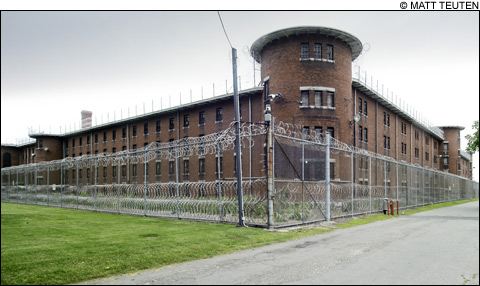
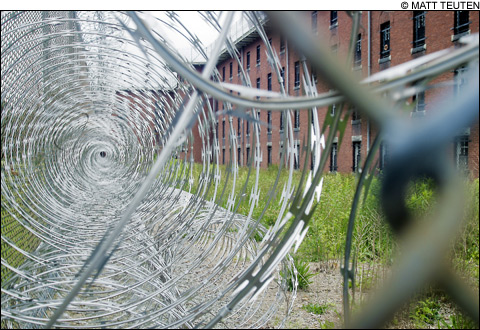
BEHIND THE FENCE: Lately, Old Colony has been in the spotlight, but for all the wrong reasons. The facility is troubled by allegations of racism, sexual misconduct, and egregious human-rights violations. And in a state where convicts reportedly kill themselves at more than three times the national rate, in 2010 OCCC is the facility where prisoners are most likely to commit suicide.
Wall of silence
In December 2006, an officer named Joel Weinrebe was terminated from his employment at OCCC. Court documents show that events leading up to the 10-year veteran's dismissal included a melee from two years earlier, when Weinrebe dragged his girlfriend by her hair down a flight of stairs and beat her on the cold concrete outside his Brockton home. When police arrived on the scene, Weinrebe, despite being on suspension from the DOC at the time, was carrying a loaded gun and wearing his department-issued badge around his neck. Six months later, he was arrested for the incident and charged with possession of a class D controlled substance, carrying a dangerous weapon, and domestic assault and battery. Weinrebe's girlfriend later dropped the domestic-violence charges, but he didn't get his job back.

The most revealing part of Weinrebe's case is what one of his fellow guards said, on the witness stand, about DOC culture. Steve Kenneway, then the president of the Officers Union, had previously been an Army officer at the notorious Abu Ghraib prison in Iraq. At a 2006 hearing for Weinrebe's appeal to be reinstated — which was denied — Kenneway testified that Weinrebe should keep his position at OCCC. According to court records: "Lt. Kenneway testified on behalf of the Appellant that domestic violence is becoming more prevalent among DOC personnel and that DOC requested a meeting to discuss this problem. Kenneway further testified that a Captain who shot his wife and spent six months in jail is still a Captain after the case against him was dropped. He also testified that there is a current case pending regarding a Captain who pistol-whipped his wife, and is still a Captain."

Offensive as his comments may have been, Kenneway was just following guidelines. Union members are candid about their brotherly discretion, so much that the Officers Union once published a list of commandments including: "Though shall not 'rat' on a fellow employee," "Thou shall not surrender thyself to management," and "Though shall not bear witness against one another." In a 2006 review titled "Improving Prison Safety: Breaking the Code of Silence" that was published in the Journal of Law & Policy, former DOC commissioner Dennehy wrote: "Corrections professionals must face the fact that we work in an environment where a long-established code of silence can flourish and overshadow common sense and common decency." The Officers Union did not return Phoenix requests for comment.

Old Colony's stop-snitching culture is a recurring theme on public Web forums where DOC employees post anonymous notes. One current target of officers' angst is Mendes — the previously mentioned lieutenant accused of scheming the DOC out of thousands of dollars that he allegedly used to buy, among other items, a bow and arrow and multiple semi-automatic weapons. (Mendes's attorney denies the charges.) Fearing that Mendes will flip in order to pad his own punishment, commenters have suggested the use of intimidation: "Mendes is being arraigned on the 28 of July in Brockton [Superior Court]" read one recent thread. "Let's get together and hire a bus to go and see this rat bastard sweat and cry in court. This ballsucker should go down like the coward he is."

Mendes is not the only contentious topic in OCCC forums. On the Bitch Boards, as they're better known, officers chat about everything from sexual-misconduct investigations and union elections to specific prisoners and co-workers. They have plenty to bitch about. In the past year alone: former officer Robin Pearson was arraigned on charges of having inappropriate sexual relations with a convict. Manson Brown escaped OCCC minimum-security, bringing the state legislature's attention to the prevalence of contraband cell phones behind bars. (Brown's escape also strained relations between prison officials and the Bridgewater Police Department, since Old Colony officers did not alert local authorities until two hours after discovering that Brown was missing.) All this while emotionally disturbed inmates are being transferred to OCCC, and the struggle between Caucasian guards and minority prisoners seems headed for an irreconcilable deadlock.

Unhappy Kwanzaa
The case of Darrell Jones illustrates how petty and vindictive the relationship between guards and inmates can be.

In 2008, Jones, a prison-reform activist who, at the time, was serving his life sentence at Old Colony, collaborated with Boston's Center for Teen Empowerment on the educational film Voices from Behind the Wall. In the documentary, he and other OCCC prisoners told cautionary tales of their trials on the street and behind bars. The film was made with the DOC's permission, but inmates claim the effort angered Old Colony staffers. Boston City Councilor Chuck Turner later suggested officers were dismayed that the film "linked [inmates] to the community in a positive way."

Jones was one of many inmates who clashed with OCCC staff over attempts to organize and educate minority inmates. Inspired by the prisoners at Walpole who four decades earlier converged as Black African Nations Toward Unity (BANTU) to study African-American history and resist systematic oppression, in 2008 Jones and other Old Colony inmates formed the African Heritage Coalition (AHC). The AHC alleges that through arbitrary sanctions, officers and administrators sought to cripple their group, which by early 2009 had grown to numbers in excess of 80 members. In May of that year, Jones charged, in an audio clip posted online, that officer harassment of inmates had reached its "highest level ever," and complained, "They're tearing down anything we try to do that's positive." The day after his tirade went public, Jones was placed in segregation.

Six days later, Jones' appeal for outside help appeared to have been answered: he received a visit from State Rep. Gloria Fox. Accompanied by Jones's girlfriend and collaborator Joanna Marinova, Fox had come to discuss claims of officer misconduct leveled by AHC members. The day after that meeting, Jones was relocated to MCI-Norfolk.

A civil action will examine whether OCCC officers manipulated the media to retaliate against Jones. In May 2009, the Boston Herald ran a page-one story titled "Fox in the Big House," in which reporter Jessica Van Sack wrote: "State Rep. Gloria L. Fox is under scrutiny for allegedly sneaking a murderer's girlfriend — previously bagged for engaging in 'sexual acts' with the killer con — into [OCCC]." Citing two confidential sources, the article claimed that Fox, the state rep from Roxbury, used her legislative privilege to bypass security checkpoints for the purpose of escorting Marinova into restricted areas where she could see Jones. In the month that followed, the Herald trumpeted the story despite proof in disciplinary reports that charges of "sexual acts" between Jones and Marinova had in fact been dismissed by OCCC supervisors. Marinova is suing the Herald and WHDH-TV7 over the story, claiming the outlets based their reports on false information that was maliciously leaked by OCCC employees.


A CIVIL ACTION will examine whether Old Colony officers manipulated the media’s reporting on a visit by State Representative Gloria Fox (above) to retaliate against a prisoner.
A complete loop
With aggravation building between inmates and administrators, in June of 2009 Commissioner Clarke and Governor Patrick visited OCCC to interview both sides. Among the grievances reported by inmates at the meeting, and that were recorded by AHC members, including Roxbury native Mac Hudson: OCCC employees "use policies and practices to discriminate against minorities in every facet of their institutional life," from job assignments, re-entry programs, and visitation policies to meal quality and recreational opportunities. Most damning were allegations that officers conspired against certain groups and individuals by manipulating the disciplinary process. Yet the DOC has no official report from this meeting, and refused to make the commissioner available for comment. Instead, a spokesperson tells the Phoenix that "Clarke is not aware of such [racial] tension."

Incidents of alleged prisoner abuse were investigated by an officer who was himself accused of prisoner abuse. In April of last year, OCCC's grievance coordinator — who processes inmate complaints — was accused of beating and choking a handcuffed minority prisoner, yet was allowed to continue working in that position.

While the allegations against him were still under review, the grievance officer handled another formal complaint by an inmate named Jackson Leonard. "The correctional staff are enticing inmates here with arbitrary rules and policies to cause a negative response," Leonard wrote. "I am afraid that this constant torture is going to cause hopelessness."

The grievance officer's official response sheds light on how such complaints were handled at OCCC: "I [sic] was determined through the investigative process that the Officers . . . are following there [sic] job duties to the letter of the Institutional rules, and it has been determined that they have been fair with [sic] in treating every inmate in [Leonard's unit]. Equally."

"This is an elaborate system that's a complete loop," says Susan Mortimer of the Massachusetts Statewide Harm Reduction Coalition. "It looks great from the outside, but the documents just go back and forth, since the grievance procedure serves to protect the DOC and no one else. Anyone who steps forward and criticizes the process will be punished and met with resistance — that's just the way it is."

Minority inmates claim that even cultural celebrations are used as tools of arbitrary punishment. AHC leader Mac Hudson claims he was transferred from Old Colony to Shirley's medium-security facility after a "successful" Juneteenth event. And on December 26 of last year, AHC members say they were unjustifiably denied admission to a long-planned Kwanzaa festivity. Grievance officers eventually conceded that the members had been turned away because of administrative miscommunication.

This may seem like a mildly unfortunate if not insignificant gesture to outsiders and officers. But the incident echoed events that famously set the DOC facility at Walpole into a frenzy nearly 40 years earlier. In 1972, then-Walpole superintendent Raymond Porelle locked down the prison just hours before a long-anticipated Kwanzaa congregation. With families and community members waiting outside in the cold, Porelle cancelled the party despite allowing the Irish-American and Italian-American heritage groups to host family on Christmas. What followed became known as the "Kwanzaa lockdown"; for more than three months, white and black prisoners unified to rebel against staff, and were in turn beaten and deprived of food. As a result, many hanged themselves before the protest ended.


HISTORY REPEATS ITSELF: In 1972, Walpole was locked down just hours before a long-anticipated Kwanzaa congregation. For more than three months, white and black prisoners unified to rebel against staff, and were in turn beaten and deprived of food. As a result, many hanged themselves before the protest ended. A similar racial rift recently occurred at Old Colony.
'We need to come together'
In December 2006, MCI-Walpole convict Glen Bourgeois hung himself behind a closed cell door — just four months after he was relocated from OCCC for having an affair with a DOC employee. Bourgeois had also complained about migraine headaches for two months, and said that his physical condition was ignored by medical staff. (The DOC denies this.) In a suicide note left behind, he wrote: "It really sucks that death is a better choice than living under the present prison conditions. I hope for the prisoners left behind things get better if not I fear I will be seeing a lot more of you."

Exactly one week before Bourgeois killed himself at Walpole, convicted murderer Eduardo Soto hung himself by a bed sheet at OCCC, while six months earlier inmate Steven Koumaris took a razor to his femoral artery and neck after repeated complaints of officer abuse went unanswered. More recently, in March of this year, OCCC inmate Michael Caputo suffocated himself with a plastic bag. The same month, John Pappargeris — who had alleged to advocate attorneys that he was denied his anti-psychotic medication — hung himself in an OCCC mental-health unit. His case remains open.

The Bitch Boards provide an enlightening look into how certain officers feel about mentally ill inmates, and particularly those who hurt themselves. One thread, on a board addressed to all DOC officers, reads: "You might have been in corrections too long if . . . You have contemplated holding a seminar titled 'Suicide — Getting It Right the First Time.' " On the OCCC-specific board, a post from last month asked: "Just who had the idea that moving all these brains full of mush into one prison would work out? Can't wait till [sic] a dozen or more cut up at the same time."

The man who led the charge in transferring mentally ill patients to OCCC is Commissioner Clarke — the same administrator who the DOC claims is not aware of racial tensions at Old Colony. Reformers, including inmate-turned-advocate Dellelo, say Clarke is not interested in reducing recidivism rates. Clarke is president of the American Correctional Association, a national trade organization. He is heavily criticized for spending significant time traveling outside of Massachusetts, for his history of double-bunking maximum-risk prisoners, and, most of all, for failing to institute meaningful re-entry programs. In the 2011 DOC budget, only one percent of expenditures will go toward job training and rehabilitation.

"When you put people behind the wall, and you don't teach them how to socialize in a positive way, there are going to be problems," says Dellelo. "You have to rehabilitate the prisoners or else it's just going to be more of the status quo."

Adds Darrin Howell, a longtime volunteer at OCCC and candidate for state representative in the Sixth Suffolk District: "If we're serious about public safety and about reducing violence and recidivism in our communities, we need to come together. [Re-entry] initiatives play an important role in this dialogue and healing process because they bring together community leaders, victims, as well as perpetrators to speak out against violence in one collective voice."

Not everyone is so dismissive of the effort underway at OCCC. A source who still works with the department, and has worked with mentally ill convicts at Old Colony, says the DOC is making its best effort under the circumstances, and that it's unrealistic to think that any prison can be re-wired overnight: "You can't fire everybody," she says. "That's not a fault of the department — that's just how it is. You just have to force it — that's why change happens slowly."

The inmates tell a different story. "If you bring those mentally ill inmates here they will not be safe," says Jones, who is now incarcerated at MCI-Norfolk. "They will be abused mentally and physically, and they will not be carefully watched over. I'm calling for an investigation before they bring any of those mentally ill inmates here. It's time for them to look at what's going on."

Chris Faraone can be reached atcfaraone@phx.com.
READ MORE - Troubled Over Bridgewater Old Colony Correctional Center has been plagued by suicide, overcrowding, and brutality — and things are only getting worse

The reform-proof prison Why Massachusetts' correctional system hasn't gotten any better

Wednesday, September 8, 2010

The reform-proof prison
Why Massachusetts' correctional system hasn't gotten any better
By CHRIS FARAONE  |  September 8, 2010

In March 2004, Kathleen Dennehy was hired as the new Department of Correction (DOC) commissioner. The first woman ever to hold the job, she had served nearly 30 years in the system, working as a deputy commissioner and before that as superintendent of the women's prison in Framingham. The challenges before Dennehy were grave; in August 2003, defrocked Catholic priest and serial child rapist John Geoghan was strangled to death by a white supremacist in his cell at the Souza Baranowski Correctional Center in Shirley, casting a negative light on the department.
In response to the subsequent uproar, then-governor Mitt Romney and his secretary of public safety, Ed Flynn, tapped Massachusetts Attorney General Scott Harshbarger to head an investigatory panel, the Governor's Commission on Corrections Reform (GCCR). The final Harshbarger report concluded that Geoghan had been severely harassed at Walpole, where the priest was initially held, and that at Shirley, Geoghan had landed in a vulnerable cell block as a result of officers citing him for unwarranted disciplinary infractions.

The Harshbarger report was ugly, and over the next three years, the DOC's Office of Investigative Services struck officers with 312 charges of misconduct, resulting in the firing of more than 100 guards across the department. Seventy-three officers were found guilty of illegally assaulting convicts, and 98 were found to have participated in illicit sexual misconduct with prisoners. The report also proposed strategies for purging the DOC of rogue guards deemed unwilling to accept the department's heightened standards. The Massachusetts Correction Officers Federated Union (MCOFU) fought hard against the DOC's crusade, directing much of its spite at the woman who Romney chose to spearhead the invigorated state prison reform effort.

From the beginning of her tenure as commissioner, Dennehy clashed with union loyalists intent on maintaining the status quo. Reps from the Massachusetts Correction Officers Federated Union (MCOFU) declined to show up at initial meetings to draft a new department vision statement, and, five months after Dennehy's start, officers hit her with a vote of no confidence. But in the years that followed, until Governor Patrick replaced her with Harold Clarke in 2007, it got worse: Dennehy reported that her car tires were slashed during one prison visit; union members followed her with an inflatable rat and hired private investigators to pursue her; and an underground officer newsletter caricatured the commissioner performing oral sex.

It's no surprise that Dennehy locked ideological horns with the union. MCOFU's then-president Steve Kenneway had just completed a tour in Iraq, where he served at Abu Ghraib as an Army reservist. When the notorious Baghdad prison came under scrutiny for outrageous human-rights violations that were exposed in a series of incriminating pictures, Kenneway publicly defended his military comrades, stating that he never witnessed a single inappropriate interrogation. Dennehy, on the other hand, was tasked in to lead the biggest Massachusetts jail reform initiative in 40 years.
One proposed change that was met with vitriol by union members pertained to system-wide disciplinary and grievance processes. Historically, convict complaints had little chance of reaching DOC administrators beyond prison walls, as each facility operated as its own fiefdom in which investigations of prisoner abuse were discreetly addressed or completely ignored. Dennehy sought increased accountability, not only in how grievances were handled, but for officers who abused their power. Only third party DOC administrators, she believed, could admonish rogue officers.

In a May 2005 interview on Fox News, Kenneway made his union's gripes public: "[Dennehy] is a very weak leader," he told Bill O'Reilly. "An indication of that is just how many people are leaving this department in droves in the past year . . . Our most experienced officers are leaving because they don't want to work for [Dennehy]." In the interview, Kenneway did not mention that more than 100 of those fleeing officers were evading sanctions, discipline, and even legal recourse.
READ MORE - The reform-proof prison Why Massachusetts' correctional system hasn't gotten any better

Public Statement: Resignation from New Black Panther Party

Sunday, May 9, 2010

PUBLIC STATEMENT
Jamarhl Crawford aka UNO The Prophet
Resignation from New Black Panther Party

After much deliberation it has become necessary to release a public statement regarding my recent resignation from the New Black Panther Party as of March 24th, 2010. There is no dramatic story or salacious details. This is merely the result of my personal, political and revolutionary evolution. I became a member of the New Black Panther Party in May of 2002 and instantly became the Boston Chapter Chairman. Within a year or so, I rose through the ranks to proudly serve as National Minister of Information and act as National Ambassador of Hip-Hop. For 8 years I have worked with the NBPP in continuation of the legacy of the Honorable Dr. Khallid Abdul Muhammad under the leadership of National Chairman Atty. Malik Zulu Shabazz and working with National Chief of Staff Min. Hashim Nzinga.

I have had the opportunity and good fortune to serve our people across the country and meet with some of our most talented and brilliant scholars, activists, organizers, soldiers, entrepreneurs and entertainers. I have worked diligently to ensure the NBPP is able to take advantage of the latest technologies in print, publishing, graphic design, web design and internet radio. I worked to get our 10 pt. program and 9 local objectives translated into Spanish and Haitian Creole in an effort to broaden our impact as well as developed the ability to accept online applications which led to thousands of new applicants across the globe. In short, my resignation is not indicative of any hostile feelings. On the contrary, I feel like my work is done and my mission has been accomplished within the NBPP and now it is the time for another individual to take the baton and continue to move forward taking the party to new heights.

My resignation in no way signifies any denunciation, repudiation, loss or lack of faith in Pro-Black, Conscious, Revolutionary, Pan-Afrikan or Black Nationalist ideologies. I remain an active supporter of all efforts towards the total Liberation of the entire Afrikan Diaspora and oppressed People of Color worldwide. I remain a mortal opponent of White Supremacy, Racism and the power of the rich over the poor. I remain a supporter of Reparations and I stand for the freedom of all of our Political Prisoners and Exiles. I remain a community organizer and activist, locally and nationally and continue all of my activities in the Revolutionary Hip-Hop Movement.

I have written this public statement for the benefit of those I organize with and have associations with across the country. I do not want my resignation to cause any confusion but to clearly state I am no longer a member, National Official or in the National Central Committee. In any event, all of us who are working towards our common goal of our ultimate and total liberation have only one common enemy and we suffer under one common condition. Let us all continue to work in the spirit of all of our ancestors; Hon. Marcus Garvey, Malcolm X, Harriet Tubman, Nat Turner and the millions of our people who lost their lives in the Black Holocaust of the Trans-Atlantic Slave Trade.

For those who wish to join or seek more information on the New Black Panther Party, please see the website www.newblackpanther.org or www.blackpowermovement.org this is where you will find all info on the NBPP as well as upcoming events such as the Black Power Convention May 28-31 in ATL, GA.


In Unity,

Jamarhl Crawford
aka UNO The Prophet
READ MORE - Public Statement: Resignation from New Black Panther Party


Labels

Twitter