


 Posts
Posts


Court upholds sentence for son of Boston police officer convicted of plotting Columbine-style massacre
http://www.universalhub.com/2010/court-upholds-sentence-son-boston-police-officer-c
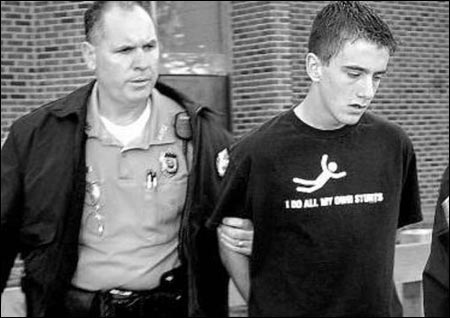
The Supreme Judicial Court ruled today that Joseph Nee was fairly convicted on a charge he conspired with other students at Marshfield High School to massacre students and teachers they didn't like.
Nee was convicted in 2008 and served nine months in state prison. In his appeal, Nee, son of Boston patrolmens union President Thomas Nee, argued the verdict should be overturned because he had renounced his part in the plot by telling a Marshfield police officer about it before it could be carried out.
In a unanimous ruling, the state's highest court said that even if it agreed Nee had a right to argue "renunciation" - something Massachusetts law does not seem to allow - it still would have found him guilty:
For the defendant to be entitled to the affirmative defense of renunciation, he must first have acknowledged that he conspired to commit a crime. This the defendant did not do.
At the meeting at the Marshfield police station the defendant did not inform the police of his own participation in the conspiracy to "shoot up" the school. Nor is there evidence that he informed [the other students in the plot], or anyone else that he was abandoning the conspiracy. Rather, when the defendant spoke to the police about the plan, he placed exclusive blame on Kerns. He cannot be found to have "renounced" an enterprise in which he denied participation.
For the complete ruling
http://www.universalhub.com/2010/commonwealth-vs-joseph-nee
COMMONWEALTH vs. Joseph NEE
By adamg - 10/27/10 - 11:06 am
NOTICE: The slip opinions and orders posted on this Web site are subject to formal revision and are superseded by the advance sheets and bound volumes of the Official Reports. This preliminary material will be removed from the Web site once the advance sheets of the Official Reports are published. If you find a typographical error or other formal error, please notify the Reporter of Decisions, Supreme Judicial Court, John Adams Courthouse, 1 Pemberton Square, Suite 2500, Boston, MA 02108-1750; (617) 557-1030; SJCReporter@sjc.state.ma.us
COMMONWEALTH vs. Joseph NEE.
SJC-10634.
September 7, 2010. - October 27, 2010.
Conspiracy. Evidence, Conspiracy.
INDICTMENT found and returned in the Superior Court Department on October 22, 2004.
The case was heard by Charles M. Grabau, J.
The Supreme Judicial Court granted an application for direct appellate review.
Frances L. Robinson (Thomas Drechsler with her) for the defendant.
Karen H. O'Sullivan, Assistant District Attorney, for the Commonwealth.
Present: Marshall, C.J., Ireland, Spina, Cowin, Cordy, Botsford, & Gants, JJ.
MARSHALL, C.J.
In February, 2008, after a jury-waived trial in the Superior Court, the defendant was convicted of conspiracy to commit murder in connection with a Columbine-style plot [FN1] to kill students and school personnel at a public high school in the Commonwealth. [FN2] See G.L. c. 274, § 7. He was sentenced to two and one-half years in a house of correction, nine months to be served with the balance suspended, and two years of probation commencing on his release. The defendant appealed, and we granted his application for direct appellate review. [FN3] The defendant argues that we must reverse the conviction because (1) the evidence at trial was insufficient to establish that he had the requisite intent to commit conspiracy; (2) the judge erred in refusing to recognize and apply the renunciation defense; [FN4] and (3) refusing to apply the renunciation defense in this case would violate the defendant's due process rights where it was not clear whether the defense was available when the defendant committed the acts for which he was convicted. We affirm.
1. Facts. We summarize the evidence presented at trial in the light most favorable to the Commonwealth, considering the evidence at the close of the Commonwealth's case. See Commonwealth v. Kelley, 370 Mass. 147, 150 (1976). [FN5]
On September 16, 2004, the defendant, Daniel Farley, and Joseph Sullivan, then all students at Marshfield High School (school), attended a meeting with five Marshfield police officers at the Marshfield police station. The meeting had been arranged at the defendant's request by Officer Helen Gray, a Marshfield police officer assigned to duty as the school's "resource officer." [FN6] Over the course of a few hours the defendant and his companions informed the police officers that since the previous winter another student, Tobin Kerns, had developed an elaborate plot to "blow up the school." The defendant, in particular, described the plot in detail. None of the three friends indicated that they were involved in the plot, or implicated each other in the plot.
Marshfield police officers subsequently arrested Kerns and obtained a warrant to search his home, where they discovered, among other things, a list of supplies and weaponry in a notebook, and evidence of computer searches pertaining to weapons, pipe bombs, and other explosives. See Commonwealth v. Kerns, 449 Mass. 641, 646 (2007).
The defendant did not testify at trial. Farley and Sullivan testified pursuant to grants of immunity. [FN7] They testified that during the winter of 2003 and spring of 2004, they would "hang out" with Kerns and the defendant "[a]lmost every day." In the winter of 2003, the defendant told Farley of a plan to "shoot up" the school and asked whether Farley was interested in joining him. On a subsequent occasion when Kerns was also present, the defendant asked Kerns whether Kerns would be interested in joining the defendant in "shooting up the school." Kerns and the defendant together discussed the plan with Sullivan and asked him whether he would be interested in participating. The plan that Kerns and the defendant proposed involved a multifaceted assault on the school to take place the following school year on or near the anniversary of the murders at Columbine High School. Kerns and the defendant, along with Farley, Sullivan, and perhaps one other student, were to shoot and kill targeted students, teachers, and other staff at the school using an assortment of automatic and semiautomatic weapons. They would set trip wire explosives, line the hallway with napalm, and place bicycle locks on the main and rear doors to the school to prevent escape. [FN8] The defendant told Farley that "he wanted to be exactly like Eric Harris," one of the perpetrators of the Columbine mass murder.
Together, Kerns and the defendant developed a list of ingredients for explosives and other necessary supplies, and a list of names of specific students and staff at the school whom they planned to kill. They took a map of the school from Officer Gray's office at the school and drew another map by hand; at least one map was labeled with entry points and other information relevant to the planned attack. In the spring of 2004, the defendant and Kerns together attempted to make napalm by mixing gasoline and Styrofoam. The defendant acquired copper tubing and other materials necessary to build a pipe bomb; he also tried to build an explosive device using gunpowder, duct tape, a plastic breath mint container, and a candle fuse, which he unsuccessfully attempted to ignite in the woods. The remnants of the device were later discovered by the police.
In April, 2004, Kerns and the defendant asked another student, Timothy Courchene, to join the planned attack. During the conversation, the defendant showed Courchene a list of names, said that the plan was to "take out" certain people on the list, and discussed various details of the scheme, including the use of bicycle locks and pipe bombs. At the end of the conversation, at which Farley and Sullivan were also present, the defendant displayed a large knife and threatened to cut out the tongue of anyone who spoke to the police about the plot. [FN9]
The defendant spoke about Columbine frequently. He dressed like the perpetrators of the Columbine attack, and stated that he believed what they had perpetrated was "cool" and that they were "heroes." He had a "fascination for weaponry," bragged about his ability to acquire firearms, and "several times" asked a fellow student to take firearms from the student's father for the defendant's use. He asked another student in the spring of 2004 whether her brother could "get him a gun." The defendant, Kerns, Farley, and Sullivan engaged in target practice using BB guns in the Ferry Hill Thicket, a wooded area in Marshfield. The defendant suggested that targets on the tree represented parts of the human body.
The defendant lived in Kerns's house for approximately one month in the late spring or early summer of 2004. He left when Kerns was hospitalized after attempting suicide. On one occasion, after visiting Kerns in the hospital, the defendant punched the roof of a car, said that the people at the hospital were "brainwashing" Kerns and that he should not be there, and suggested "breaking [Kerns] out."
In September, 2004, shortly after the commencement of the school year, the defendant approached Officer Gray and told her that "Kerns was scaring him." He asked to return later that day with Farley, and at the later meeting both students told Officer Gray that they were frightened of Kerns and that "they really needed to talk about something that was going on." Officer Gray arranged a meeting for the defendant and Farley with herself and police officers at the Marshfield police station. Sullivan joined in the meeting. Because the circumstances of the meeting are significant in our consideration of this appeal, we summarize it in detail.
Prior to the meeting, the defendant told Farley and Sullivan that he would do the talking so as not to "incriminate" them. [FN10] The defendant said that they were going to the meeting in order to tell the police "what [Kerns] was going to do and to keep our mouths shut."
The defendant began by telling the officers that Kerns had threatened him and his family. He stated that he was frightened, that Kerns had recounted to him in great detail certain tortures he knew about, and that Kerns had told the defendant that he spied on people when they were sleeping. The defendant also declared that Kerns had weapons and had threatened him in August with a knife in a dispute over Kerns's girl friend. He stated that Kerns had an "obsession" with Satanism.
When the police officers asked whether the students had anything more to say, the defendant told his companions, "I'll do the talking," and proceeded to detail how Kerns "had a plot to blow up the school." [FN11] Specifically, the defendant told the police officers that Kerns planned to use "napalm, pipes, propane gas bombs" and "Tech-9's, assault rifles" in the attack. He stated that Kerns said he would need the help of two others to carry out the attack, and that the three would enter the school at certain entrances, corral the students into specified areas, and separate the students and faculty to be killed from those that would remain unharmed. The defendant told the police that Kerns planned to cause diversionary explosions at gasoline stations at opposite ends of town in order to tie up emergency response operations. He claimed that Kerns planned to be on the school roof when emergency personnel arrived "so he could pick [them] off," and then to escape from a tunnel beneath the school. The defendant informed the police officers about the existence and contents of a notebook listing materials to be used in the attack, and told the police where in Kerns's home they could find the notebook. [FN12] The defendant also told the police that he was present when Kerns attempted to detonate a homemade bomb in a wooded area.
Over the course of the several hours they spoke with the police officers, neither the defendant nor his friends indicated that they had planned to participate with Kerns in the attack. Rather, the defendant led the officers to believe, as Officer Gray testified, that Kerns "developed this whole thing himself and [the defendant] was just a follower," who was not in concert with Kerns.
2. Trial. The judge denied the defendant's motions for a required finding of not guilty at the close of the Commonwealth's case and at the close of the evidence. On several occasions during the trial defense counsel asked the judge to apply the renunciation defense, as set out in Model Penal Code § 5.03(6). [FN13] The judge declined to do so, explaining that it was for the Appeals Court or this court to adopt the defense, and that he had "followed the decision law of the Commonwealth."
We turn now to the defendant's arguments on appeal.
3. Sufficiency of the evidence. We first consider the defendant's contention that the Commonwealth failed to introduce evidence sufficient to prove that he intended to carry out the alleged conspiracy. Our review is limited to the familiar standard, "whether after viewing the evidence in the light most favorable to the prosecution, any rational trier of fact could have found the essential elements of the crime beyond a reasonable doubt" (emphasis in original). Commonwealth v. Latimore, 378 Mass. 671, 677 (1979), quoting Jackson v. Virginia, 443 U.S. 307, 319 (1979).
"The elements of conspiracy are 'a combination of two or more persons, by some concerted action, to accomplish some criminal or unlawful purpose....' " Commonwealth v. Benson, 389 Mass. 473, 479, cert. denied, 464 U.S. 915 (1983), quoting Commonwealth v. Dyer, 243 Mass. 472, 483 (1922). Accord Commonwealth v. Hunt, 4 Met. 111, 123-125 (1842). The defendant does not dispute that there was sufficient evidence to prove that he joined in an agreement with Kerns or that the purpose of that agreement was to do something unlawful. He argues only that the evidence was insufficient to prove that he intended to carry out the plan.
The argument is unavailing. To prove a conspiracy, the Commonwealth "must prove that the defendant combined with another 'with the intention' " to "commit the object crime"--here, mass murder. Commonwealth v. Frazier, 410 Mass. 235, 245 (1991), quoting Commonwealth v. Cantres, 405 Mass. 238, 244 (1989). Proof of an overt act in furtherance of the conspiracy is not necessary. See Carrasquillo v. Commonwealth, 422 Mass. 1014, 1015 (1996) (crime of conspiracy "is complete on the formation of the unlawful agreement"); Commonwealth v. Beneficial Fin. Co., 360 Mass. 188, 249 (1971), cert. denied sub nom. Farrell v. Massachusetts, 407 U.S. 910 (1972), and sub nom. Beneficial Fin. Co. v. Massachusetts, 407 U.S. 914 (1972), quoting Commonwealth v. Judd, 2 Mass. 329, 337 (1807) (crime of conspiracy "is complete, when the confederacy is made, and any act done in pursuance of it is no constituent part of the offence, but merely an aggravation of it").
While "mere knowledge of an unlawful conspiracy is not sufficient to make one a member of it," Commonwealth v. Beal, 314 Mass. 210, 222 (1943), the "line that separates mere knowledge of unlawful conduct and participation in it, is 'often vague and uncertain. It is within the province of the [fact finder] to determine from the evidence whether a particular defendant had crossed that line.' " Commonwealth v. Cerveny, 387 Mass. 280, 287 (1982), quoting Commonwealth v. Beneficial Fin. Co., supra at 250.
As with other crimes, a conspiracy may, and typically is, proved by circumstantial evidence, because often there is no direct evidence that an "agreement" was reached. "The acts of different persons who are shown to have known each other, or to have been in communication with each other, directed towards the accomplishment of the same object, especially if by the same means or in the same manner, may be satisfactory proof of a conspiracy." Commonwealth v. Beneficial Fin. Co., supra at 251, quoting Attorney Gen. v. Tufts, 239 Mass. 458, 494 (1921). Accord Commonwealth v. Smith, 163 Mass. 411, 417-418 (1895).
In this case, the Commonwealth presented sufficient evidence to prove beyond a reasonable doubt that the defendant entered an agreement with Kerns with the intention to commit mass murder. See Commonwealth v. Frazier, supra. Multiple witnesses testified that the defendant either initiated or assisted in the development of an elaborate plan to "shoot up" the school. There was substantial evidence that the defendant prepared to carry out the attack by learning about and experimenting with explosive devices, and attempting to acquire firearms. Moreover, the defendant attempted to recruit Courchene and others to participate in the attack and threatened to cut out the tongue of anyone who spoke about the plan to the police. From this and other evidence, the judge could properly find that the defendant in fact reached an agreement with his friends to kill people at the school. See Commonwealth v. Benson, supra.
The defendant, claiming that the weight of the evidence was insufficient for conviction, points to (1) Officer Gray's testimony that, when the defendant, Farley, and Sullivan revealed the details of the plan to the Marshfield police, "all three ... never admitted to being involved ... nor did they think that [Kerns] was going to commit this plan into action until recently [when Kerns] began acting strange"; (2) Farley's testimony that, when the defendant spoke of the plan, Farley thought the defendant "was just talking stupid"; (3) Sullivan's testimony that it was the defendant's idea to talk with the police because the defendant was "afraid" that Kerns "would hurt someone"; (4) evidence that the defendant had at one point told Sullivan, and had written in a class assignment, that the actions of the perpetrators of the Columbine attack were "wrong"; and (5) testimony from Farley and Sullivan that, when he reached eighteen years of age and was therefore eligible to do so, the defendant declined Kerns's request to obtain a firearms identification card and to buy him weapons. The judge was entitled to discredit or place little weight on this evidence, considering the ample evidence of the defendant's criminal intent recounted above. There was no error.
We next turn to the defendant's arguments concerning the renunciation defense.
4. Claimed renunciation by the defendant of criminal purpose. [FN14] The defendant claims that the judge erred in refusing to recognize and apply the renunciation defense. Putting to one side the issue of the availability of that defense in Massachusetts, we conclude that there was no error because the evidence in this case would not entitle the defendant to the benefits of the renunciation defense under any reasonable interpretation of the defense as set out in Model Penal Code § 5.03(6). [FN15]
First, the renunciation defense applies in circumstances where the defendant manifests a "complete and voluntary renunciation of his criminal purpose" (emphasis added). American Law Institute's Model Penal Code and Commentaries § 5.03(6) (1985). To "renounce" is to "give up" or "abandon." Black's Law Dictionary 1410 (9th ed.2009). See id. at 1412 (defining "renunciation" as "[c]omplete and voluntary abandonment of criminal purpose ... before a crime is committed" [emphasis added] ). Fundamentally, then, renunciation "posits prior participation." State v. Hughes, 215 N.J.Super. 295, 298 (1986) (renunciation defense not available to defendant who denied involvement in conspiracy in testimony at trial). For the defendant to be entitled to the affirmative defense of renunciation, he must first have acknowledged that he conspired to commit a crime. [FN16] This the defendant did not do.
At the meeting at the Marshfield police station the defendant did not inform the police of his own participation in the conspiracy to "shoot up" the school. Nor is there evidence that he informed Kerns, Farley, Sullivan, or anyone else that he was abandoning the conspiracy. Rather, when the defendant spoke to the police about the plan, he placed exclusive blame on Kerns. He cannot be found to have "renounced" an enterprise in which he denied participation. See American Law Institute's Model Penal Code and Commentaries, supra at § 5.03(7)(c), at 384 (renunciation accomplished "only if and when [the defendant] advises those with whom he conspired of his abandonment or he informs the law enforcement authorities of the existence of the conspiracy and of his participation therein " (emphasis added). [FN17]
Second, providing the protection of the renunciation defense in the circumstances of this case would have defeated the purpose of the defense. The drafters of the Model Penal Code explained that the renunciation defense seeks to avoid punishing individuals whose actions suggest that they do not merit such punishment, and to provide an incentive for individuals who have entered into a conspiracy to "desist from pressing forward with their criminal designs." Id. at § 5.03 comment 6, at 457-458. Neither of these aims would be furthered by granting the benefits of the renunciation defense to one who failed to reveal and renounce his own crime.
Because we conclude that the evidence would not entitle the defendant to the benefits of the renunciation defense as set out in Model Penal Code § 5.03(6), we do not address the defendant's argument that we should adopt the affirmative defense of renunciation to the crime of conspiracy. [FN18]
5. Due process. The defendant contends that at the time he reported to the police, "it was not clear whether the defense of renunciation was or was not available to the defendant." Thus, he reasons, he would be denied due process were we to apply to his case the "new doctrine" that renunciation was legally unavailable to him. Because we have determined that a renunciation defense would not apply to the defendant on the facts of this case, this argument is unavailing. [FN19]
Judgment affirmed.
FN1. On April 20, 1999, at Columbine High School in Columbine, Colorado, two students, Eric Harris and Dylan Klebold, killed twelve students and one teacher, and injured twenty-one others, in a massacre that was widely covered by the American media. See, e.g., 10 Years Later, The Real Story Behind Columbine, USA Today, April 14, 2009.
FN2. The defendant was acquitted on separate indictments charging promotion of anarchy, G.L. c. 264, § 11, and threatened use of deadly weapons, G.L. c. 269, § 14 (b ).
FN3. A single justice of the Appeals Court denied the defendant's application for a stay of his sentence pending appeal.
FN4. The American Law Institute's Model Penal Code § 5.03(6) (1985) provides: "Renunciation of Criminal Purpose. It is an affirmative defense [to a charge of conspiracy] that the actor, after conspiring to commit a crime, thwarted the success of the conspiracy, under circumstances manifesting a complete and voluntary renunciation of his criminal purpose."
FN5. The Commonwealth's proof did not "deteriorate between the time that the Commonwealth rested and the close of all the evidence." Commonwealth v. Kelley, 370 Mass. 147, 150 n. 1 (1976).
FN6. Officer Helen Gray testified that the "resource officer" serves as the liaison between the school and the police department, with responsibilities for "law enforcement, law-related education and ... security" at the school.
FN7. Farley and Sullivan were granted immunity after their testimony to the grand jury. Both also testified pursuant to grants of immunity at Kerns's trial, which took place sixteen months before the trial of the defendant. See Commonwealth v. Kerns, 449 Mass. 641, 647 (2007).
FN8. The defendant and Kerns also developed a "Plan B," which would involve breaking into the homes of certain students, administrators, and teachers at night and slitting their throats.
FN9. Timothy Courchene later told Farley that he did not want to participate in the plan.
FN10. The defendant also told Farley and Sullivan that he had destroyed some papers that he claimed could be used as evidence against him.
FN11. Officer Gray testified that although Farley and Sullivan tried to speak up at various times during the meeting, and did corroborate parts of the defendant's story, the defendant did most of the talking, telling his companions "that he knows how to handle these things" and that, "I will take care of this. I can do the talking. I know how to talk to police."
FN12. Detective Stephen Marcolini of the Marshfield police department testified on cross-examination that he had the handwriting from the notebook analyzed by experts at the Plymouth County sheriff's department. The handwriting was determined to be that of Kerns, but the analysis was unable conclusively to identify who drew a map found in the notebook.
FN13. In addition, at the judge's request, the defendant submitted a memorandum of law before the conclusion of the trial in which he set forth the jury instructions that he would have requested had the trial proceeded before a jury, and that he asked the judge to apply. The memorandum included the following requested instruction:
"RENUNCIATION It is a defense that the actor, after conspiring to commit a crime, thwarted the success of the conspiracy under circumstances manifesting a complete and voluntary renunciation of his criminal purpose. If the Commonwealth has failed to prove beyond a reasonable doubt that the defendant did not manifest a voluntary renunciation of his criminal purpose, you must find him not guilty. Model Penal Code Section 5.03(6)."
FN14. We are concerned here only with renunciation of criminal purpose as a defense to the crime of conspiracy. The question whether and to what extent renunciation may be relevant for other purposes, such as the statute of limitations, is not before us and we do not address it.
FN15. The defendant has asked that we adopt the affirmative defense of renunciation as that defense is set out in Model Penal Code § 5.03(6). See note 4, supra. We need not and do not consider any of the variations on the Model Penal Code that have been adopted by States that recognize renunciation as a defense to criminal conspiracy.
FN16. The defense in each of the other jurisdictions cited by the defendant, although varying in other minor respects from § 5.03(6) of the Model Penal Code, applies to a conspirator who "renounces" or manifests a "renunciation" of his criminal purpose, objective, or intent. See Colo.Rev.Stat. § 18-2-203 (2010); Conn. Gen.Stat. § 53a-48(b) (2009); Del.Code Ann. tit. 11, § 541(a) (2007); Fla. Stat. § 777.04(5)(c) (2010); Ky.Rev.Stat. Ann. § 506.060(1) (LexisNexis 2008); N.H.Rev.Stat. Ann. § 629:3(III) (West 2007); N.J. Stat. Ann. § 2C:5-2(e) (West 2005); N.Y. Penal Law § 40.10(4) (McKinney 2009); N.D. Cent.Code § 12.1-06-05(3)(b) (LexisNexis Supp.2009); Ohio Rev.Code Ann. § 2923.01(I) (Baldwin Supp.2010); Or.Rev.Stat. Ann. § 161.460 (West 2003); 18 Pa. Cons.Stat. Ann. § 903(f) (Purdon 1998); Tex. Penal Code Ann. § 15.04(b) (West 2003).
FN17. Renunciation must also be "complete and voluntary " (emphasis added). American Law Institute's Model Penal Code and Commentaries § 5.03(6) (1985). A "voluntary abandonment occurs when there is a change in the actor's purpose that is not influenced by outside circumstances." Id. at § 5.01(4) comment 8, at 356. See id. at § 5.03(6) explanatory note, at 385 (applying definition of "voluntary" set out in § 5.01[4] ). Renunciation is not "voluntary" if it is "motivated, in whole or in part, by circumstances, not present or apparent at the inception of the actor's course of conduct, that increase the probability of detection or apprehension or that make more difficult the accomplishment of the criminal purpose." Id. at § 5.01(4), at 297. When the defendant revealed the plan to the police, he was "motivated, in whole or in part," by Kerns's hospitalization and either fear that Kerns would expose the conspiracy or the subsequent deterioration of his relationship with Kerns, both of which were "circumstances, not present or apparent at the inception" of the conspiracy, that increased the "probability of detection or apprehension" of the defendant and made "more difficult the accomplishment" of his plan to attack the school.
FN18. Although we do not address the defendant's invitation to adopt renunciation as a defense to conspiracy, we do not agree with the suggestion that, whatever merits renunciation may have in the context of conspiracy, its incorporation into our criminal law must be left to the Legislature. General Laws c. 274, § 7, sets forth a sentencing scheme for "[a]ny person who commits the crime of conspiracy," without defining its elements. We have held that the Legislature intended to adopt the common-law definition of "conspiracy." See, e.g., Commonwealth v. Benson, 389 Mass. 473, 479, cert. denied, 464 U.S. 915 (1983) (relying on common law to define offense of conspiracy); Commonwealth v. Beneficial Fin. Co., 360 Mass. 188, 249 (1971), cert. denied sub nom. Farrell v. Massachusetts, 407 U.S. 910 (1972), and sub nom. Beneficial Fin. Co. v. Massachusetts, 407 U.S. 914 (1972) (relying on "well settled" common-law "principles," which are "determinative" of crime of conspiracy). See also Commonwealth v. Stokes, 440 Mass. 741, 747 (2004), quoting Commonwealth v. Burke, 392 Mass. 688, 690 (1984) (where Legislature does not define term, "we presume that its intent is to incorporate the common-law definition of that term, 'unless the intent to alter it is clearly expressed' ").
FN19. Commonwealth v. Klein, 372 Mass. 823 (1977), on which the defendant relies, is readily distinguishable. In that case, the court adopted new limits on an arresting citizen's right to use deadly force, see id. at 830-831, and concluded that as a matter of fairness the standards it established should not be applied retroactively to the defendant, because it could not "fairly be said that the defendant was on notice of the possible criminality of his conduct." Id. at 833. Here, the defendant was on notice of the crime itself, conspiracy. See, e.g., Commonwealth v. Nighelli, 13 Mass.App.Ct. 590, 596 (1982).
READ MORE - Court upholds sentence for son of Boston police officer and Union head convicted of plotting Columbine-style massacre
By adamg - 10/27/10 - 11:27 am
http://www.universalhub.com/2010/court-upholds-sentence-son-boston-police-officer-c
The Supreme Judicial Court ruled today that Joseph Nee was fairly convicted on a charge he conspired with other students at Marshfield High School to massacre students and teachers they didn't like.
Nee was convicted in 2008 and served nine months in state prison. In his appeal, Nee, son of Boston patrolmens union President Thomas Nee, argued the verdict should be overturned because he had renounced his part in the plot by telling a Marshfield police officer about it before it could be carried out.
In a unanimous ruling, the state's highest court said that even if it agreed Nee had a right to argue "renunciation" - something Massachusetts law does not seem to allow - it still would have found him guilty:
For the defendant to be entitled to the affirmative defense of renunciation, he must first have acknowledged that he conspired to commit a crime. This the defendant did not do.
At the meeting at the Marshfield police station the defendant did not inform the police of his own participation in the conspiracy to "shoot up" the school. Nor is there evidence that he informed [the other students in the plot], or anyone else that he was abandoning the conspiracy. Rather, when the defendant spoke to the police about the plan, he placed exclusive blame on Kerns. He cannot be found to have "renounced" an enterprise in which he denied participation.
For the complete ruling
http://www.universalhub.com/2010/commonwealth-vs-joseph-nee
COMMONWEALTH vs. Joseph NEE
By adamg - 10/27/10 - 11:06 am
NOTICE: The slip opinions and orders posted on this Web site are subject to formal revision and are superseded by the advance sheets and bound volumes of the Official Reports. This preliminary material will be removed from the Web site once the advance sheets of the Official Reports are published. If you find a typographical error or other formal error, please notify the Reporter of Decisions, Supreme Judicial Court, John Adams Courthouse, 1 Pemberton Square, Suite 2500, Boston, MA 02108-1750; (617) 557-1030; SJCReporter@sjc.state.ma.us
COMMONWEALTH vs. Joseph NEE.
SJC-10634.
September 7, 2010. - October 27, 2010.
Conspiracy. Evidence, Conspiracy.
INDICTMENT found and returned in the Superior Court Department on October 22, 2004.
The case was heard by Charles M. Grabau, J.
The Supreme Judicial Court granted an application for direct appellate review.
Frances L. Robinson (Thomas Drechsler with her) for the defendant.
Karen H. O'Sullivan, Assistant District Attorney, for the Commonwealth.
Present: Marshall, C.J., Ireland, Spina, Cowin, Cordy, Botsford, & Gants, JJ.
MARSHALL, C.J.
In February, 2008, after a jury-waived trial in the Superior Court, the defendant was convicted of conspiracy to commit murder in connection with a Columbine-style plot [FN1] to kill students and school personnel at a public high school in the Commonwealth. [FN2] See G.L. c. 274, § 7. He was sentenced to two and one-half years in a house of correction, nine months to be served with the balance suspended, and two years of probation commencing on his release. The defendant appealed, and we granted his application for direct appellate review. [FN3] The defendant argues that we must reverse the conviction because (1) the evidence at trial was insufficient to establish that he had the requisite intent to commit conspiracy; (2) the judge erred in refusing to recognize and apply the renunciation defense; [FN4] and (3) refusing to apply the renunciation defense in this case would violate the defendant's due process rights where it was not clear whether the defense was available when the defendant committed the acts for which he was convicted. We affirm.
1. Facts. We summarize the evidence presented at trial in the light most favorable to the Commonwealth, considering the evidence at the close of the Commonwealth's case. See Commonwealth v. Kelley, 370 Mass. 147, 150 (1976). [FN5]
On September 16, 2004, the defendant, Daniel Farley, and Joseph Sullivan, then all students at Marshfield High School (school), attended a meeting with five Marshfield police officers at the Marshfield police station. The meeting had been arranged at the defendant's request by Officer Helen Gray, a Marshfield police officer assigned to duty as the school's "resource officer." [FN6] Over the course of a few hours the defendant and his companions informed the police officers that since the previous winter another student, Tobin Kerns, had developed an elaborate plot to "blow up the school." The defendant, in particular, described the plot in detail. None of the three friends indicated that they were involved in the plot, or implicated each other in the plot.
Marshfield police officers subsequently arrested Kerns and obtained a warrant to search his home, where they discovered, among other things, a list of supplies and weaponry in a notebook, and evidence of computer searches pertaining to weapons, pipe bombs, and other explosives. See Commonwealth v. Kerns, 449 Mass. 641, 646 (2007).
The defendant did not testify at trial. Farley and Sullivan testified pursuant to grants of immunity. [FN7] They testified that during the winter of 2003 and spring of 2004, they would "hang out" with Kerns and the defendant "[a]lmost every day." In the winter of 2003, the defendant told Farley of a plan to "shoot up" the school and asked whether Farley was interested in joining him. On a subsequent occasion when Kerns was also present, the defendant asked Kerns whether Kerns would be interested in joining the defendant in "shooting up the school." Kerns and the defendant together discussed the plan with Sullivan and asked him whether he would be interested in participating. The plan that Kerns and the defendant proposed involved a multifaceted assault on the school to take place the following school year on or near the anniversary of the murders at Columbine High School. Kerns and the defendant, along with Farley, Sullivan, and perhaps one other student, were to shoot and kill targeted students, teachers, and other staff at the school using an assortment of automatic and semiautomatic weapons. They would set trip wire explosives, line the hallway with napalm, and place bicycle locks on the main and rear doors to the school to prevent escape. [FN8] The defendant told Farley that "he wanted to be exactly like Eric Harris," one of the perpetrators of the Columbine mass murder.
Together, Kerns and the defendant developed a list of ingredients for explosives and other necessary supplies, and a list of names of specific students and staff at the school whom they planned to kill. They took a map of the school from Officer Gray's office at the school and drew another map by hand; at least one map was labeled with entry points and other information relevant to the planned attack. In the spring of 2004, the defendant and Kerns together attempted to make napalm by mixing gasoline and Styrofoam. The defendant acquired copper tubing and other materials necessary to build a pipe bomb; he also tried to build an explosive device using gunpowder, duct tape, a plastic breath mint container, and a candle fuse, which he unsuccessfully attempted to ignite in the woods. The remnants of the device were later discovered by the police.
In April, 2004, Kerns and the defendant asked another student, Timothy Courchene, to join the planned attack. During the conversation, the defendant showed Courchene a list of names, said that the plan was to "take out" certain people on the list, and discussed various details of the scheme, including the use of bicycle locks and pipe bombs. At the end of the conversation, at which Farley and Sullivan were also present, the defendant displayed a large knife and threatened to cut out the tongue of anyone who spoke to the police about the plot. [FN9]
The defendant spoke about Columbine frequently. He dressed like the perpetrators of the Columbine attack, and stated that he believed what they had perpetrated was "cool" and that they were "heroes." He had a "fascination for weaponry," bragged about his ability to acquire firearms, and "several times" asked a fellow student to take firearms from the student's father for the defendant's use. He asked another student in the spring of 2004 whether her brother could "get him a gun." The defendant, Kerns, Farley, and Sullivan engaged in target practice using BB guns in the Ferry Hill Thicket, a wooded area in Marshfield. The defendant suggested that targets on the tree represented parts of the human body.
The defendant lived in Kerns's house for approximately one month in the late spring or early summer of 2004. He left when Kerns was hospitalized after attempting suicide. On one occasion, after visiting Kerns in the hospital, the defendant punched the roof of a car, said that the people at the hospital were "brainwashing" Kerns and that he should not be there, and suggested "breaking [Kerns] out."
In September, 2004, shortly after the commencement of the school year, the defendant approached Officer Gray and told her that "Kerns was scaring him." He asked to return later that day with Farley, and at the later meeting both students told Officer Gray that they were frightened of Kerns and that "they really needed to talk about something that was going on." Officer Gray arranged a meeting for the defendant and Farley with herself and police officers at the Marshfield police station. Sullivan joined in the meeting. Because the circumstances of the meeting are significant in our consideration of this appeal, we summarize it in detail.
Prior to the meeting, the defendant told Farley and Sullivan that he would do the talking so as not to "incriminate" them. [FN10] The defendant said that they were going to the meeting in order to tell the police "what [Kerns] was going to do and to keep our mouths shut."
The defendant began by telling the officers that Kerns had threatened him and his family. He stated that he was frightened, that Kerns had recounted to him in great detail certain tortures he knew about, and that Kerns had told the defendant that he spied on people when they were sleeping. The defendant also declared that Kerns had weapons and had threatened him in August with a knife in a dispute over Kerns's girl friend. He stated that Kerns had an "obsession" with Satanism.
When the police officers asked whether the students had anything more to say, the defendant told his companions, "I'll do the talking," and proceeded to detail how Kerns "had a plot to blow up the school." [FN11] Specifically, the defendant told the police officers that Kerns planned to use "napalm, pipes, propane gas bombs" and "Tech-9's, assault rifles" in the attack. He stated that Kerns said he would need the help of two others to carry out the attack, and that the three would enter the school at certain entrances, corral the students into specified areas, and separate the students and faculty to be killed from those that would remain unharmed. The defendant told the police that Kerns planned to cause diversionary explosions at gasoline stations at opposite ends of town in order to tie up emergency response operations. He claimed that Kerns planned to be on the school roof when emergency personnel arrived "so he could pick [them] off," and then to escape from a tunnel beneath the school. The defendant informed the police officers about the existence and contents of a notebook listing materials to be used in the attack, and told the police where in Kerns's home they could find the notebook. [FN12] The defendant also told the police that he was present when Kerns attempted to detonate a homemade bomb in a wooded area.
Over the course of the several hours they spoke with the police officers, neither the defendant nor his friends indicated that they had planned to participate with Kerns in the attack. Rather, the defendant led the officers to believe, as Officer Gray testified, that Kerns "developed this whole thing himself and [the defendant] was just a follower," who was not in concert with Kerns.
2. Trial. The judge denied the defendant's motions for a required finding of not guilty at the close of the Commonwealth's case and at the close of the evidence. On several occasions during the trial defense counsel asked the judge to apply the renunciation defense, as set out in Model Penal Code § 5.03(6). [FN13] The judge declined to do so, explaining that it was for the Appeals Court or this court to adopt the defense, and that he had "followed the decision law of the Commonwealth."
We turn now to the defendant's arguments on appeal.
3. Sufficiency of the evidence. We first consider the defendant's contention that the Commonwealth failed to introduce evidence sufficient to prove that he intended to carry out the alleged conspiracy. Our review is limited to the familiar standard, "whether after viewing the evidence in the light most favorable to the prosecution, any rational trier of fact could have found the essential elements of the crime beyond a reasonable doubt" (emphasis in original). Commonwealth v. Latimore, 378 Mass. 671, 677 (1979), quoting Jackson v. Virginia, 443 U.S. 307, 319 (1979).
"The elements of conspiracy are 'a combination of two or more persons, by some concerted action, to accomplish some criminal or unlawful purpose....' " Commonwealth v. Benson, 389 Mass. 473, 479, cert. denied, 464 U.S. 915 (1983), quoting Commonwealth v. Dyer, 243 Mass. 472, 483 (1922). Accord Commonwealth v. Hunt, 4 Met. 111, 123-125 (1842). The defendant does not dispute that there was sufficient evidence to prove that he joined in an agreement with Kerns or that the purpose of that agreement was to do something unlawful. He argues only that the evidence was insufficient to prove that he intended to carry out the plan.
The argument is unavailing. To prove a conspiracy, the Commonwealth "must prove that the defendant combined with another 'with the intention' " to "commit the object crime"--here, mass murder. Commonwealth v. Frazier, 410 Mass. 235, 245 (1991), quoting Commonwealth v. Cantres, 405 Mass. 238, 244 (1989). Proof of an overt act in furtherance of the conspiracy is not necessary. See Carrasquillo v. Commonwealth, 422 Mass. 1014, 1015 (1996) (crime of conspiracy "is complete on the formation of the unlawful agreement"); Commonwealth v. Beneficial Fin. Co., 360 Mass. 188, 249 (1971), cert. denied sub nom. Farrell v. Massachusetts, 407 U.S. 910 (1972), and sub nom. Beneficial Fin. Co. v. Massachusetts, 407 U.S. 914 (1972), quoting Commonwealth v. Judd, 2 Mass. 329, 337 (1807) (crime of conspiracy "is complete, when the confederacy is made, and any act done in pursuance of it is no constituent part of the offence, but merely an aggravation of it").
While "mere knowledge of an unlawful conspiracy is not sufficient to make one a member of it," Commonwealth v. Beal, 314 Mass. 210, 222 (1943), the "line that separates mere knowledge of unlawful conduct and participation in it, is 'often vague and uncertain. It is within the province of the [fact finder] to determine from the evidence whether a particular defendant had crossed that line.' " Commonwealth v. Cerveny, 387 Mass. 280, 287 (1982), quoting Commonwealth v. Beneficial Fin. Co., supra at 250.
As with other crimes, a conspiracy may, and typically is, proved by circumstantial evidence, because often there is no direct evidence that an "agreement" was reached. "The acts of different persons who are shown to have known each other, or to have been in communication with each other, directed towards the accomplishment of the same object, especially if by the same means or in the same manner, may be satisfactory proof of a conspiracy." Commonwealth v. Beneficial Fin. Co., supra at 251, quoting Attorney Gen. v. Tufts, 239 Mass. 458, 494 (1921). Accord Commonwealth v. Smith, 163 Mass. 411, 417-418 (1895).
In this case, the Commonwealth presented sufficient evidence to prove beyond a reasonable doubt that the defendant entered an agreement with Kerns with the intention to commit mass murder. See Commonwealth v. Frazier, supra. Multiple witnesses testified that the defendant either initiated or assisted in the development of an elaborate plan to "shoot up" the school. There was substantial evidence that the defendant prepared to carry out the attack by learning about and experimenting with explosive devices, and attempting to acquire firearms. Moreover, the defendant attempted to recruit Courchene and others to participate in the attack and threatened to cut out the tongue of anyone who spoke about the plan to the police. From this and other evidence, the judge could properly find that the defendant in fact reached an agreement with his friends to kill people at the school. See Commonwealth v. Benson, supra.
The defendant, claiming that the weight of the evidence was insufficient for conviction, points to (1) Officer Gray's testimony that, when the defendant, Farley, and Sullivan revealed the details of the plan to the Marshfield police, "all three ... never admitted to being involved ... nor did they think that [Kerns] was going to commit this plan into action until recently [when Kerns] began acting strange"; (2) Farley's testimony that, when the defendant spoke of the plan, Farley thought the defendant "was just talking stupid"; (3) Sullivan's testimony that it was the defendant's idea to talk with the police because the defendant was "afraid" that Kerns "would hurt someone"; (4) evidence that the defendant had at one point told Sullivan, and had written in a class assignment, that the actions of the perpetrators of the Columbine attack were "wrong"; and (5) testimony from Farley and Sullivan that, when he reached eighteen years of age and was therefore eligible to do so, the defendant declined Kerns's request to obtain a firearms identification card and to buy him weapons. The judge was entitled to discredit or place little weight on this evidence, considering the ample evidence of the defendant's criminal intent recounted above. There was no error.
We next turn to the defendant's arguments concerning the renunciation defense.
4. Claimed renunciation by the defendant of criminal purpose. [FN14] The defendant claims that the judge erred in refusing to recognize and apply the renunciation defense. Putting to one side the issue of the availability of that defense in Massachusetts, we conclude that there was no error because the evidence in this case would not entitle the defendant to the benefits of the renunciation defense under any reasonable interpretation of the defense as set out in Model Penal Code § 5.03(6). [FN15]
First, the renunciation defense applies in circumstances where the defendant manifests a "complete and voluntary renunciation of his criminal purpose" (emphasis added). American Law Institute's Model Penal Code and Commentaries § 5.03(6) (1985). To "renounce" is to "give up" or "abandon." Black's Law Dictionary 1410 (9th ed.2009). See id. at 1412 (defining "renunciation" as "[c]omplete and voluntary abandonment of criminal purpose ... before a crime is committed" [emphasis added] ). Fundamentally, then, renunciation "posits prior participation." State v. Hughes, 215 N.J.Super. 295, 298 (1986) (renunciation defense not available to defendant who denied involvement in conspiracy in testimony at trial). For the defendant to be entitled to the affirmative defense of renunciation, he must first have acknowledged that he conspired to commit a crime. [FN16] This the defendant did not do.
At the meeting at the Marshfield police station the defendant did not inform the police of his own participation in the conspiracy to "shoot up" the school. Nor is there evidence that he informed Kerns, Farley, Sullivan, or anyone else that he was abandoning the conspiracy. Rather, when the defendant spoke to the police about the plan, he placed exclusive blame on Kerns. He cannot be found to have "renounced" an enterprise in which he denied participation. See American Law Institute's Model Penal Code and Commentaries, supra at § 5.03(7)(c), at 384 (renunciation accomplished "only if and when [the defendant] advises those with whom he conspired of his abandonment or he informs the law enforcement authorities of the existence of the conspiracy and of his participation therein " (emphasis added). [FN17]
Second, providing the protection of the renunciation defense in the circumstances of this case would have defeated the purpose of the defense. The drafters of the Model Penal Code explained that the renunciation defense seeks to avoid punishing individuals whose actions suggest that they do not merit such punishment, and to provide an incentive for individuals who have entered into a conspiracy to "desist from pressing forward with their criminal designs." Id. at § 5.03 comment 6, at 457-458. Neither of these aims would be furthered by granting the benefits of the renunciation defense to one who failed to reveal and renounce his own crime.
Because we conclude that the evidence would not entitle the defendant to the benefits of the renunciation defense as set out in Model Penal Code § 5.03(6), we do not address the defendant's argument that we should adopt the affirmative defense of renunciation to the crime of conspiracy. [FN18]
5. Due process. The defendant contends that at the time he reported to the police, "it was not clear whether the defense of renunciation was or was not available to the defendant." Thus, he reasons, he would be denied due process were we to apply to his case the "new doctrine" that renunciation was legally unavailable to him. Because we have determined that a renunciation defense would not apply to the defendant on the facts of this case, this argument is unavailing. [FN19]
Judgment affirmed.
FN1. On April 20, 1999, at Columbine High School in Columbine, Colorado, two students, Eric Harris and Dylan Klebold, killed twelve students and one teacher, and injured twenty-one others, in a massacre that was widely covered by the American media. See, e.g., 10 Years Later, The Real Story Behind Columbine, USA Today, April 14, 2009.
FN2. The defendant was acquitted on separate indictments charging promotion of anarchy, G.L. c. 264, § 11, and threatened use of deadly weapons, G.L. c. 269, § 14 (b ).
FN3. A single justice of the Appeals Court denied the defendant's application for a stay of his sentence pending appeal.
FN4. The American Law Institute's Model Penal Code § 5.03(6) (1985) provides: "Renunciation of Criminal Purpose. It is an affirmative defense [to a charge of conspiracy] that the actor, after conspiring to commit a crime, thwarted the success of the conspiracy, under circumstances manifesting a complete and voluntary renunciation of his criminal purpose."
FN5. The Commonwealth's proof did not "deteriorate between the time that the Commonwealth rested and the close of all the evidence." Commonwealth v. Kelley, 370 Mass. 147, 150 n. 1 (1976).
FN6. Officer Helen Gray testified that the "resource officer" serves as the liaison between the school and the police department, with responsibilities for "law enforcement, law-related education and ... security" at the school.
FN7. Farley and Sullivan were granted immunity after their testimony to the grand jury. Both also testified pursuant to grants of immunity at Kerns's trial, which took place sixteen months before the trial of the defendant. See Commonwealth v. Kerns, 449 Mass. 641, 647 (2007).
FN8. The defendant and Kerns also developed a "Plan B," which would involve breaking into the homes of certain students, administrators, and teachers at night and slitting their throats.
FN9. Timothy Courchene later told Farley that he did not want to participate in the plan.
FN10. The defendant also told Farley and Sullivan that he had destroyed some papers that he claimed could be used as evidence against him.
FN11. Officer Gray testified that although Farley and Sullivan tried to speak up at various times during the meeting, and did corroborate parts of the defendant's story, the defendant did most of the talking, telling his companions "that he knows how to handle these things" and that, "I will take care of this. I can do the talking. I know how to talk to police."
FN12. Detective Stephen Marcolini of the Marshfield police department testified on cross-examination that he had the handwriting from the notebook analyzed by experts at the Plymouth County sheriff's department. The handwriting was determined to be that of Kerns, but the analysis was unable conclusively to identify who drew a map found in the notebook.
FN13. In addition, at the judge's request, the defendant submitted a memorandum of law before the conclusion of the trial in which he set forth the jury instructions that he would have requested had the trial proceeded before a jury, and that he asked the judge to apply. The memorandum included the following requested instruction:
"RENUNCIATION It is a defense that the actor, after conspiring to commit a crime, thwarted the success of the conspiracy under circumstances manifesting a complete and voluntary renunciation of his criminal purpose. If the Commonwealth has failed to prove beyond a reasonable doubt that the defendant did not manifest a voluntary renunciation of his criminal purpose, you must find him not guilty. Model Penal Code Section 5.03(6)."
FN14. We are concerned here only with renunciation of criminal purpose as a defense to the crime of conspiracy. The question whether and to what extent renunciation may be relevant for other purposes, such as the statute of limitations, is not before us and we do not address it.
FN15. The defendant has asked that we adopt the affirmative defense of renunciation as that defense is set out in Model Penal Code § 5.03(6). See note 4, supra. We need not and do not consider any of the variations on the Model Penal Code that have been adopted by States that recognize renunciation as a defense to criminal conspiracy.
FN16. The defense in each of the other jurisdictions cited by the defendant, although varying in other minor respects from § 5.03(6) of the Model Penal Code, applies to a conspirator who "renounces" or manifests a "renunciation" of his criminal purpose, objective, or intent. See Colo.Rev.Stat. § 18-2-203 (2010); Conn. Gen.Stat. § 53a-48(b) (2009); Del.Code Ann. tit. 11, § 541(a) (2007); Fla. Stat. § 777.04(5)(c) (2010); Ky.Rev.Stat. Ann. § 506.060(1) (LexisNexis 2008); N.H.Rev.Stat. Ann. § 629:3(III) (West 2007); N.J. Stat. Ann. § 2C:5-2(e) (West 2005); N.Y. Penal Law § 40.10(4) (McKinney 2009); N.D. Cent.Code § 12.1-06-05(3)(b) (LexisNexis Supp.2009); Ohio Rev.Code Ann. § 2923.01(I) (Baldwin Supp.2010); Or.Rev.Stat. Ann. § 161.460 (West 2003); 18 Pa. Cons.Stat. Ann. § 903(f) (Purdon 1998); Tex. Penal Code Ann. § 15.04(b) (West 2003).
FN17. Renunciation must also be "complete and voluntary " (emphasis added). American Law Institute's Model Penal Code and Commentaries § 5.03(6) (1985). A "voluntary abandonment occurs when there is a change in the actor's purpose that is not influenced by outside circumstances." Id. at § 5.01(4) comment 8, at 356. See id. at § 5.03(6) explanatory note, at 385 (applying definition of "voluntary" set out in § 5.01[4] ). Renunciation is not "voluntary" if it is "motivated, in whole or in part, by circumstances, not present or apparent at the inception of the actor's course of conduct, that increase the probability of detection or apprehension or that make more difficult the accomplishment of the criminal purpose." Id. at § 5.01(4), at 297. When the defendant revealed the plan to the police, he was "motivated, in whole or in part," by Kerns's hospitalization and either fear that Kerns would expose the conspiracy or the subsequent deterioration of his relationship with Kerns, both of which were "circumstances, not present or apparent at the inception" of the conspiracy, that increased the "probability of detection or apprehension" of the defendant and made "more difficult the accomplishment" of his plan to attack the school.
FN18. Although we do not address the defendant's invitation to adopt renunciation as a defense to conspiracy, we do not agree with the suggestion that, whatever merits renunciation may have in the context of conspiracy, its incorporation into our criminal law must be left to the Legislature. General Laws c. 274, § 7, sets forth a sentencing scheme for "[a]ny person who commits the crime of conspiracy," without defining its elements. We have held that the Legislature intended to adopt the common-law definition of "conspiracy." See, e.g., Commonwealth v. Benson, 389 Mass. 473, 479, cert. denied, 464 U.S. 915 (1983) (relying on common law to define offense of conspiracy); Commonwealth v. Beneficial Fin. Co., 360 Mass. 188, 249 (1971), cert. denied sub nom. Farrell v. Massachusetts, 407 U.S. 910 (1972), and sub nom. Beneficial Fin. Co. v. Massachusetts, 407 U.S. 914 (1972) (relying on "well settled" common-law "principles," which are "determinative" of crime of conspiracy). See also Commonwealth v. Stokes, 440 Mass. 741, 747 (2004), quoting Commonwealth v. Burke, 392 Mass. 688, 690 (1984) (where Legislature does not define term, "we presume that its intent is to incorporate the common-law definition of that term, 'unless the intent to alter it is clearly expressed' ").
FN19. Commonwealth v. Klein, 372 Mass. 823 (1977), on which the defendant relies, is readily distinguishable. In that case, the court adopted new limits on an arresting citizen's right to use deadly force, see id. at 830-831, and concluded that as a matter of fairness the standards it established should not be applied retroactively to the defendant, because it could not "fairly be said that the defendant was on notice of the possible criminality of his conduct." Id. at 833. Here, the defendant was on notice of the crime itself, conspiracy. See, e.g., Commonwealth v. Nighelli, 13 Mass.App.Ct. 590, 596 (1982).


